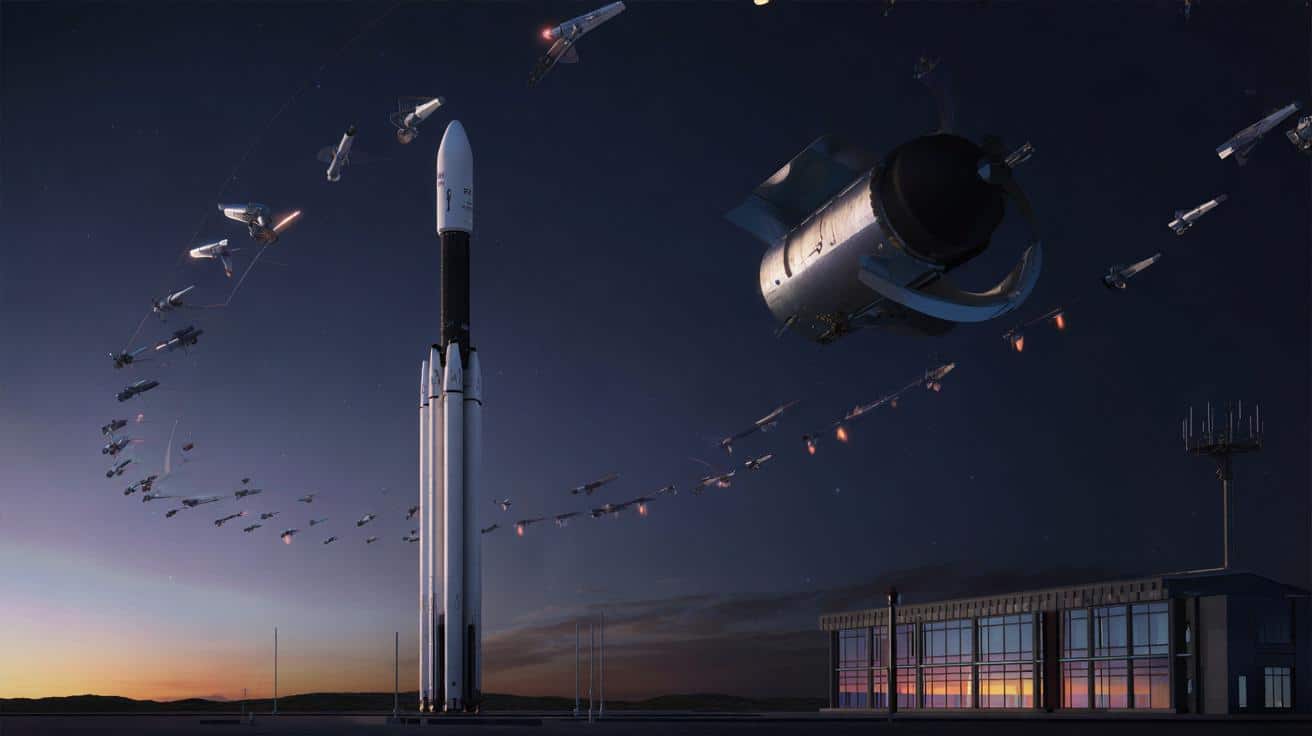
The US military has now handed SpaceX a major role in that contest, commissioning launches for a new generation of early warning and tracking satellites designed to watch hostile missiles from the moment they ignite.
SpaceX lands $739 million deal to loft missile-watch satellites
US Space Systems Command has awarded SpaceX launch contracts worth $739 million to deploy advanced missile warning and tracking satellites into low-Earth orbit (LEO). These flights will support both the Space Development Agency (SDA) and the National Reconnaissance Office (NRO), two of the Pentagon’s most influential space organisations.
The missions fall under the National Security Space Launch programme, which taps commercial rockets to deliver sensitive military hardware at lower cost and higher tempo.
By using SpaceX’s reusable rockets, the Pentagon aims to launch more satellites more often, while keeping budgets under tighter control. The new deal highlights how rapidly commercial launch providers have moved from experimental partners to core pillars of US defence planning.
Three mission packages, one strategic goal
The contract is split into three main launch groupings, each targeting a different but related mission in missile detection and tracking.
SDA-2: early tracking and fire-control support
The first package, referred to as SDA-2, includes three launches:
- Two launches carrying a combined total of 18 Tracking Layer satellites built by L3Harris
- One separate launch with eight Fire-control On Orbit-support-to-the-war Fighter (F2) space vehicles built by Millennium Space Systems
The Tracking Layer satellites will form part of a wider SDA constellation aimed at spotting missile launches in their early stages and following them through flight. Operating in LEO, they can refresh coverage quickly as the Earth rotates beneath the orbiting grid.
The F2 space vehicles have a more experimental role. They belong to a demonstration effort focused on improving US missile defence performance against highly manoeuvrable targets. That includes hypersonic glide vehicles, which can shift trajectory mid-flight and fly at extremely high speeds, complicating interception.
The F2 demo seeks to push beyond simply “seeing” a missile, towards feeding precise, real-time data into weapons that might shoot it down.
➡️ “I’m a hairdresser and here’s my best advice for 50-year-old women who want short hair”
➡️ Spain confirms order for 30 Turkish Hürjet training jets worth €2.6 billion
➡️ The Swedish Saab says it is ready to work with Airbus to develop a new fighter jet
➡️ MBDA Brings Its Thundart Rocket Out Of The Shadows For The French Army
SDA-3: expanding the tracking web
The second package, labelled SDA-3, extends the constellation further. It consists of two launches that will deliver an additional 18 Tracking Layer satellites manufactured by Lockheed Martin.
With both SDA-2 and SDA-3 in place, the US intends to build a more resilient, distributed network in orbit. The idea is that no single satellite becomes a critical failure point. If one node fails or is targeted, others can quickly take over its coverage.
NTO-5: a classified NRO mission
The third mission, known as NTO-5, supports a classified flight for the National Reconnaissance Office. Public details on the spacecraft and its exact payload remain sparse, which is typical for NRO missions.
Given the broader context of missile warning and tracking, analysts expect the NRO payload to complement the SDA’s visible architecture, perhaps with higher-resolution sensors or specialised intelligence-gathering capability.
Launch timeline: late 2020s build-out
The missions will roll out over several years:
| Mission package | Payload | Planned launch window |
|---|---|---|
| SDA-2 | 18 Tracking Layer satellites (L3Harris) + 8 F2 space vehicles (Millennium) | Starting late 2026 |
| SDA-3 | 18 Tracking Layer satellites (Lockheed Martin) | From mid-2027 |
| NTO-5 | Classified NRO payload | Early 2027 and mid-2028 |
This staggered schedule reflects both manufacturing timelines and the Pentagon’s push to field an initial capability quickly, then build it out in phases. The strategy lets the SDA test, refine and upgrade as new satellites are added.
Part of a broader push to harden US space power
The SpaceX launches sit within a wider US effort to modernise space-based defences and the digital plumbing that connects them.
In a separate move, Texas-based company GetChkd recently secured a $1.9 million contract to improve satellite communications security for the Air Force and Space Force using blockchain technology. The system uses an audited digital ledger to strictly control which users and systems can access sensitive data.
The blockchain approach aims to stop unauthorised access and limit data sharing strictly to approved satellites, sensors and command networks, across both classified and unclassified channels.
On the more offensive side of space operations, the US Space Force has been preparing two ground-based systems intended to jam Chinese and Russian reconnaissance satellites. These systems are designed to disrupt adversary surveillance by interfering with satellite signals rather than physically damaging spacecraft.
Together, these projects show a dual-track approach: defend US and allied forces with better warning and secure communications, while limiting what rivals can see in orbit.
Why low-Earth orbit matters for missile tracking
Traditional missile warning systems have relied heavily on large, expensive satellites in higher geostationary orbits. These offer wide views but can be slower to refresh and more vulnerable as single, high-value targets.
By contrast, a dense layer of smaller satellites in low-Earth orbit can watch the same regions with more frequent passes and greater redundancy. If one satellite fails or is attacked, the constellation keeps working.
For missile tracking, LEO has several advantages:
- Shorter revisit times over key regions
- Potential for better sensitivity and resolution at lower altitudes
- Scalability, as more satellites can be added quickly on commercial rockets
- Reduced unit cost, enabling “many small” instead of “few exquisite” assets
The trade-off is that more satellites are needed to maintain continuous coverage. That is where launch providers like SpaceX become central, as they can loft large batches of spacecraft in a single mission.
Key terms and what they actually mean
Several technical phrases in this programme are worth unpacking for clarity.
Tracking Layer: This refers to the cluster of satellites dedicated specifically to spotting and following missile signatures. They typically use infrared sensors to detect the intense heat from rocket engines and glide vehicles as they move through the atmosphere and near-space.
Fire-control support: Detecting a missile is only one step. To have a realistic chance of interception, ground or sea-based missile defence systems need accurate, rapid updates on its trajectory. Fire-control support satellites aim to refine that data and provide continuous, precise tracking for weapons systems.
Hypersonic threat: Hypersonic missiles travel at speeds of at least five times the speed of sound and may manoeuvre unpredictably. Traditional radars and older space sensors can struggle to track them consistently, which is why the US is pushing hard to refresh its orbital architecture.
Risks, benefits and what could go wrong
Relying more heavily on LEO constellations brings clear benefits: greater resilience, faster refresh rates and more flexible upgrades. Yet there are risks in crowding critical defence systems into an already busy orbital band.
Space debris is one concern. A collision or breakup event in a densely populated orbit could damage multiple satellites at once. Designers now factor in manoeuvring capability, end-of-life disposal plans and hardened electronics to reduce those vulnerabilities.
Another risk lies in escalation. As the US deploys more sensors and jammers, rivals may respond with their own constellations, anti-satellite weapons or cyber attacks targeting the supporting ground networks. That raises the stakes for cyber defence, hardened communications and clear rules of engagement.
At the same time, the benefits of more reliable missile tracking are hard to ignore. Better warning times reduce the chance of miscalculation in a crisis. Leaders can see more clearly what is being launched and from where, which can stabilise decision-making when minutes matter.
For now, the new SpaceX launches mark a practical step: turning strategy papers into hardware in orbit. By the late 2020s, the US hopes to have a significantly more agile, networked space shield watching for flashes of hostile missiles on the dark side of the Earth.