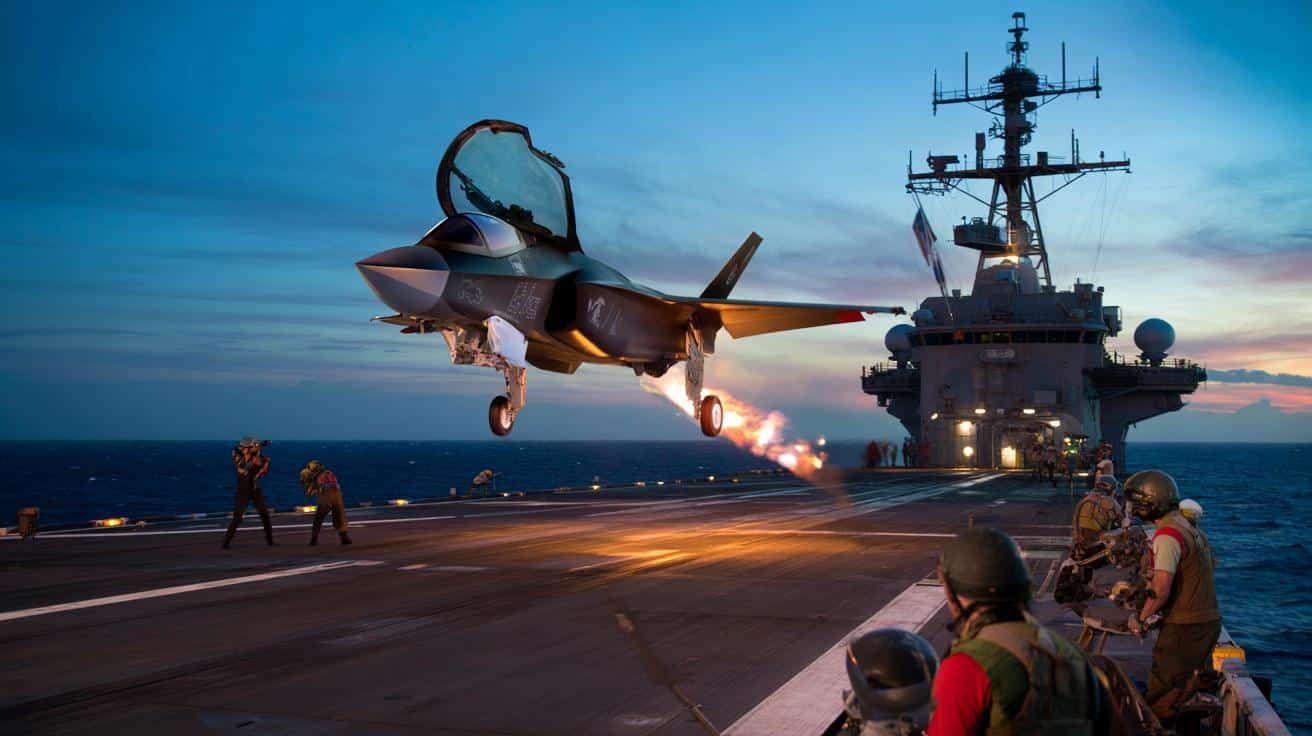
On 10 February 2026, the U.S. Navy and Marine Corps used that moment in the North Atlantic to prove that one of their veteran amphibious assault ships, USS Kearsarge, is now ready to launch and recover fifth‑generation fighter jets at sea.
A historic first for USS Kearsarge
USS Kearsarge (LHD 3), a Wasp-class amphibious assault ship commissioned in 1993, has officially joined the small group of vessels certified to operate the F‑35B Lightning II, the short takeoff and vertical landing (STOVL) variant of the Joint Strike Fighter.
The first F‑35B landing took place in the Atlantic Ocean, with a U.S. Marine Corps jet executing a vertical touchdown on the ship’s flight deck. U.S. Fleet Forces Command confirmed the event and described it as a key milestone for the Navy-Marine Corps team.
The successful F‑35B landing signals that USS Kearsarge can now project fifth‑generation air power from an amphibious platform in open ocean conditions.
Until now, Kearsarge had relied on helicopters, MV‑22B Ospreys, and legacy AV‑8B Harrier jets to provide air support for embarked Marines. The new certification shifts the ship firmly into the fifth‑generation era.
What changed on board the ship
Operating the F‑35B is not a simple plug-and-play upgrade for an older hull. The ship needed targeted modifications to safely handle the fighter’s power and data demands.
Heat, fuel and data: preparing for the F‑35B
The F‑35B’s vertical landing generates intense downward thrust and high thermal loads. Before certification, technicians and engineers focused on three main areas:
- Flight deck resilience: Heat-resistant treatments and coatings to protect the deck from the jet’s exhaust.
- Aviation fuel systems: Adjustments to support the aircraft’s requirements and tempo of operations.
- Secure data links: Upgrades to handle classified mission data and real-time targeting feeds.
During the at-sea trials, the Navy evaluated how the deck surface handled repeated vertical landings, how quickly the crew could refuel and rearm the aircraft, and whether the ship’s command-and-control systems could fully integrate the F‑35B’s sophisticated sensors into the wider task group picture.
With these changes, Kearsarge is not just hosting a new jet; it is functioning as a fifth‑generation aviation hub for the wider force.
➡️ An ‘ingenious’ Ukrainian weapon so disruptive NATO fears it more than Russia does
➡️ Nationwide recall in France after goat’s cheese contaminated with bacteria
➡️ Rheinmetall receives major order for HERO loitering munitions
➡️ Even in winter, you can sprout sweet potatoes for spring
➡️ “I’m a hairdresser and here’s my best advice for 50-year-old women who want short hair”
From helicopter carrier to multi-domain combat platform
At full load, USS Kearsarge displaces around 40,500 tons and stretches about 257 metres. The ship was originally optimised to carry a Marine Expeditionary Unit, complete with landing craft and a mix of rotary-wing aircraft for assault and support missions.
The addition of the F‑35B reshapes that model. Instead of relying mostly on helicopters and tilt-rotors for close support and transport, an amphibious ready group built around Kearsarge can now field a stealthy fixed-wing complement capable of engaging targets well inland and far out to sea.
This change folds into a broader U.S. effort to turn amphibious ships into multi-domain platforms. They are expected to handle classic beach assault roles, while contributing to air defence, long-range strike, and intelligence gathering across contested maritime regions.
Inside the F‑35B’s unique capabilities
How the STOVL system works
The F‑35B’s STOVL design allows it to operate from shorter decks like Kearsarge, rather than relying on catapults and arresting wires found on traditional aircraft carriers.
The aircraft uses a powerful Pratt & Whitney F135 engine that produces roughly 40,000 pounds of thrust. A shaft-driven lift fan, developed by Rolls‑Royce, behind the cockpit provides vertical lift when engaged, while a swivelling rear exhaust nozzle directs thrust downward for hovering and landing.
This arrangement lets the jet perform short takeoffs and true vertical landings, an ability that is especially valuable when operating from tight amphibious decks or improvised runways ashore.
More than a stealth bomber
The F‑35B’s strength is not only in its propulsion system or low radar signature. Its real edge lies in how it gathers and shares information.
Key onboard systems include:
| System | Role |
|---|---|
| AN/APG‑81 AESA radar | Long-range tracking and targeting of air and surface contacts |
| Distributed Aperture System | 360‑degree infrared coverage around the aircraft |
| Electro‑Optical Targeting System | Precision targeting for guided weapons and surveillance |
| Electronic warfare suite | Detection, jamming and self‑protection against enemy radars |
All of this data is fused into a single view for the pilot, displayed on a helmet‑mounted system. That allows the F‑35B to act as a flying sensor node as much as a strike aircraft.
An F‑35B launched from Kearsarge can spot threats, share targeting data with ships and aircraft, and guide weapons fired by others.
Weapons and missions from an amphibious deck
The F‑35B can carry several precision weapons internally, maintaining its stealth profile by keeping munitions hidden inside the fuselage. Examples include GPS‑guided JDAM bombs like the GBU‑32, the GBU‑53 StormBreaker small diameter bomb, and AIM‑120 AMRAAM air‑to‑air missiles.
When low observability is less crucial, the jet can load additional weapons on external pylons, significantly increasing its payload for close air support or maritime strike missions.
Embarked on Kearsarge, the aircraft can support a wide range of scenarios:
- Suppression of enemy air defences ahead of amphibious landings.
- Air superiority patrols over coastal or island regions.
- Precision strikes on infrastructure, armour or missile sites inland.
- Targeting and surveillance support for naval surface combatants.
Strategic value in the Atlantic and beyond
The Atlantic has once again become a contested and politically sensitive region, with renewed Russian naval activity, growing interest in Arctic routes, and pressure on NATO sea lanes. In that context, having an amphibious assault ship able to deploy F‑35Bs offers U.S. commanders more flexibility.
By putting F‑35Bs on Kearsarge, the U.S. can spread its combat air power across more ships, without always committing a full-size carrier group.
This “distributed” approach complicates an opponent’s planning. Instead of facing one obvious high‑value target, rival forces must consider multiple ships, each capable of launching stealth aircraft, helicopters, and landing craft.
For allies in Europe and the High North, the presence of an F‑35B‑capable LHD in the Atlantic also reinforces collective deterrence. It signals that amphibious forces can quickly shift from humanitarian relief or evacuation duties to high-end combat if needed.
Behind the scenes: logistics and digital backbone
To keep F‑35Bs flying from an amphibious ship, the Navy had to adjust more than flight deck coatings. Maintenance spaces, spare parts storage, and weapons handling areas all went through review and upgrade.
A key piece of the puzzle is connectivity with the ODIN logistics network, the cloud‑based system that supports F‑35 operations across the fleet. Kearsarge now needs to receive software updates, share maintenance data, and manage parts tracking while at sea, often with bandwidth constraints and security requirements.
These changes aim to sustain high sortie rates during deployments, allowing the ship to act as a credible strike platform rather than a limited demonstration asset.
What this means for the Marine Corps
For the U.S. Marine Corps, the F‑35B is central to a wider shift towards “stand‑in forces” and distributed maritime operations. Marines are rethinking how they fight, focusing on smaller, dispersed units supported by advanced sensors and long-range fires.
From Kearsarge, Marine Air-Ground Task Forces can receive persistent overhead coverage from F‑35Bs, linking ground units, artillery, and naval gunfire into one connected network. The aircraft does not just respond to calls for air support; it can also push real-time intelligence to ground commanders and naval ships.
The February 10 landing represents a practical step toward Marine formations that are lighter, more dispersed and more digitally connected, yet still backed by high-end air power.
Key terms and future scenarios
Some of the terms tied to this development can sound abstract. STOVL, for instance, simply means a jet can take off using a short run and land vertically. That extra flexibility allows commanders to operate from smaller decks, damaged runways, or temporary expeditionary airstrips ashore.
Another concept often mentioned is “sea control”. In practice, that means having enough ships, aircraft, and sensors to keep an area of ocean safe for friendly shipping while keeping an opponent’s forces at risk. An F‑35B‑equipped amphibious ship strengthens that effort by spotting hostile ships or aircraft earlier and hitting them from longer range.
Looking ahead, scenarios involving Kearsarge and its F‑35Bs could include Arctic patrols supporting freedom of navigation, rapid reinforcement of NATO allies, or crisis response in North Africa or the Mediterranean. In each case, the ability to sail with both landing craft and stealth jets on the same hull gives planners a wider menu of options.
There are risks as well. Operating cutting‑edge jets from older ships adds complexity and cost, and any incident on a crowded flight deck can have serious consequences. Balancing daily training, safety margins, and deployment demands will be a constant challenge for the crew.
Even with those constraints, the first F‑35B landing on USS Kearsarge marks a clear signal: amphibious assault ships are no longer just troop carriers with helicopters on top. They are becoming compact, multi-role strike platforms designed for a contested century at sea.