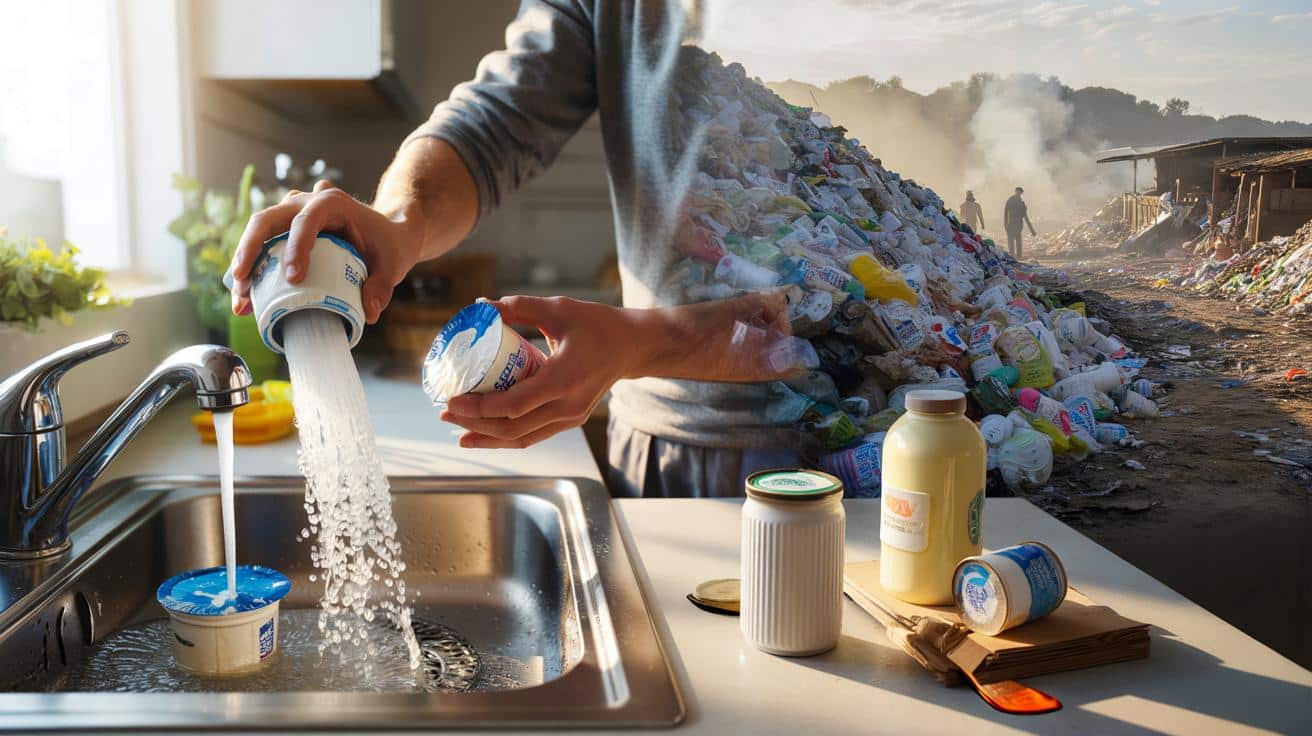
The spoon scrapes the last streaks of yogurt from the bottom of the pot. You stand over the sink, tap running, fingers getting cold as you rinse the plastic until it looks “recyclable clean”. For a second you feel oddly proud, like you’ve completed a tiny mission for the planet before work. The blue bin opens with that familiar hollow thud. Another pot saved. Another micro-dose of eco-virtue.
Then you scroll your phone on the commute and see yet another headline about plastic mountains in Asia, about microplastics in the blood of newborn babies, about “recycling scandals”. Your stomach tightens. You did your bit, right?
Some days it starts to feel like the whole system is a performance for people like you.
When rinsing yogurt pots becomes climate theater
The modern recycling ritual looks precise and almost religious. We rinse, sort, fold cardboard, peel off labels, line up colored bins like little altars of good conscience. It feels clean, controlled, like we’re on the right side of history.
Yet the numbers tell a far messier story. A tiny fraction of the world’s plastics actually come back as new products. The rest are burned, buried, or quietly shipped far away where we don’t have to see them again.
So much effort for such a small result.
Take plastics in Europe and the United States. Municipal campaigns proudly show arrows circling into infinity, but most reality checks stop short of the curb. In the US, recent research estimates that only around **5% of plastic waste** is actually recycled into new plastic. In the EU, the official rate is higher, often quoted near 40%, yet a large portion of that “recycling” is simply plastic exported or turned into low-grade material.
That yogurt pot you rinsed for 30 seconds could still be trucked to an incinerator, counted as “recovered energy”, and puffed into the sky as CO₂ and toxic fumes.
The logic is brutal. Recycling companies need clean, single-type plastics to be profitable. Your kitchen bin, on the other hand, is a chaos of shapes, colors, food residues, and mixed materials. Sorting plants do their best, but they aren’t magic. Food-stained film, dark plastics, multi-layer packaging: all that goes straight to “rejects”.
So you spend water, time, mental load on rinsing. The truck drives, the plant runs, the conveyor belts hum. Each step burns energy and cash. If the plastic is low value, the system quietly shifts the cost to taxpayers or distant countries, where burning and dumping are cheaper.
Sometimes, the eco-gesture is little more than climate theater with good lighting.
When “good” recycling does real damage
Here’s the awkward part nobody likes to say out loud. Your perfectly rinsed yogurt pot can have a worse footprint than if you’d just thrown it, unwashed, into the trash every single time. Hot water from a gas boiler, lots of detergent, electricity for the dishwasher if you toss it in there “to save time” – all that has a carbon cost.
You might be saving a theoretical gram of plastic from landfill while pumping more CO₂ into the air than the recycling process can ever offset.
*That’s the uncomfortable math behind our daily rituals.*
Picture a busy family on a Sunday evening. The sink is full, kids are shouting, someone’s making pasta. One parent stands there rinsing sauce jars and yogurt pots under streaming hot water “because they must be clean to be recycled”. They leave the tap on too long, distracted, maybe running nearly a full kettle’s worth of hot water down the drain.
Multiply that tiny scene by a million households doing the same thing, day after day. The energy burned can overshadow the marginal benefit of maybe recycling one more low-grade pot, especially when that pot may not even be accepted by the final facility.
This isn’t an argument to trash everything and give up. It’s a call to see the whole system instead of the shiny blue bin. Recycling was originally sold as a magic solution by the same industries that profit from selling disposable packaging in the first place. They shifted responsibility from producers to consumers, from regulation to personal guilt.
So we stack up “right choices” at home, while the upstream tap of useless packaging stays fully open. The emissions from producing and transporting new plastics are orders of magnitude larger than the tiny savings of our rinsing. The plain truth: **if the package never existed, you wouldn’t have to feel guilty about where it ends up.**
How to recycle less… and pollute less
The most effective “recycling” habit starts before you buy anything. When you reach for that four-pack of mini yogurts, wrapped in plastic film, with individual plastic lids and a plastic sleeve, that’s the real decision point. Choosing a big glass jar of plain yogurt, or a refill station if you have one, quietly deletes a dozen tiny dilemmas later.
Small upstream moves like this beat heroic rinsing marathons every time. Start by targeting the worst offenders: single-serve snacks, mixed-material pouches, black plastics, and anything that combines plastic + foil + paper.
Each item you don’t bring home is one less item the broken system can mishandle.
Then, simplify what you do recycle. Cold water quick rinse, not a scalding shower. Don’t obsess over microscopic traces of food; most facilities can handle a bit of residue. Skip the perfectionism that turns eco-living into a part-time job. Let’s be honest: nobody really does this every single day.
Focus on materials with a real second life: clear PET bottles, metal cans, clean cardboard. Those stand a far better chance of actually coming back as something useful than the neon multi-layer snack pouch with a cartoon tiger.
We’ve all been there, that moment when you’re holding some weird, crinkly wrapper and thinking: “If I throw this in the trash, am I a bad person?”
A veteran waste engineer once told me: “If you have to hesitate that long, the system has already failed you. Good recycling should be obvious.”➡️ US Space Command Taps SpaceX for Missile Warning, Tracking Satellites
➡️ Germany orders 200 Puma IFVs with Spike anti-tank missiles for $4.9 billion
➡️ This simple winter gesture promises hydrangeas covered in flowers by spring
➡️ Heating: the 19°C rule is over, here is the experts’ recommendation
➡️ The Swedish Saab says it is ready to work with Airbus to develop a new fighter jet
➡️ Germany contracts Polaris to develop two-stage hypersonic test vehicle
- Prioritize reduction over recycling – ask “Can I avoid this packaging?” before asking “Which bin does this go in?”
- Use cold or lukewarm water for quick rinses – heavy washing cancels the environmental benefit.
- Favor glass, metal, and plain cardboard – these have higher real recycling rates and value.
- Learn the 2–3 plastics your local plant truly wants – ignore feel-good labels that say everything is “recyclable”.
- Switch emotional energy from guilt to curiosity – follow where your waste actually goes in your city.
Maybe the trash can isn’t the real villain
Once you start pulling on this thread, the reassuring story of “good recyclers” and “bad trash throwers” begins to unravel. The real divide runs somewhere else: between societies that design waste out of the system, and those that drown in cheap disposables, then tell citizens to sort their way out.
Your yogurt pot is just a symptom. The disease is a culture that treats materials as momentary, almost imaginary, as if oil turned into plastic wasn’t going to sit around for centuries.
The next time you stand at the sink, pot in hand, you might still rinse it. You might not. But the more interesting question is: who decided your snack needed that pot in the first place, and why are they never the ones feeling guilty at night.
| Key point | Detail | Value for the reader |
|---|---|---|
| Recycling is often “theater” | Low actual recycling rates, lots of exporting, burning, and landfilling behind the scenes | Helps you stop overestimating the impact of rinsing and sorting alone |
| Upstream choices matter most | Refusing heavily packaged items and choosing reusable or high-value materials | Gives you simple, concrete levers with far higher environmental payoff |
| Simpler habits beat perfectionism | Quick cold rinses, focusing on materials that really get recycled, skipping guilt | Makes eco-living less exhausting while still cutting your real footprint |
FAQ:
- Question 1So should I stop recycling altogether?
- Answer 1No. Keep recycling, but downgrade it in your mind from “heroic act” to “basic hygiene”. The real power lies in refusing useless packaging, buying less, reusing more, and backing policies that force producers to design better systems.
- Question 2Is rinsing containers with water really that bad?
- Answer 2Rinsing lightly is fine. The problem starts when people use lots of hot water or detergent just to “earn” the recycling label. A quick cold rinse to remove most food is enough in most places; beyond that, the environmental cost often outweighs the benefit.
- Question 3Why do brands say packaging is “100% recyclable” if it’s not?
- Answer 3“Recyclable” often means “could technically be recycled under perfect conditions”. It doesn’t mean your local plant has the machines, the market, or the economics to do it. That gap between theory and practice is what fills landfills and incinerators.
- Question 4Is it true that rich countries export their plastic waste?
- Answer 4Yes. For years, huge volumes of low-value plastic have been shipped from Europe and North America to Asia, Africa, and other regions. Some is processed; a lot is burned in open air or dumped. Those emissions and health impacts don’t show up on your local recycling poster.
- Question 5What’s one change that actually moves the needle?
- Answer 5Pick a high-impact product category and cut its packaging in half. For many households, that means bottled drinks, single-serve snacks, and takeout containers. Swapping those for tap water, bulk buys, and reusables quietly erases hundreds of “recycling” decisions a year.