Instead of relying only on traditional shells and crewed aircraft, one NATO country has now ordered loitering munitions in bulk, treating them almost like standard artillery rounds. The contract, awarded to German defence group Rheinmetall for its HERO family of systems, signals a new phase in how Western forces prepare for long, high-intensity conflicts.
A NATO state turns to HERO loitering munitions
The unnamed NATO country has placed a sizeable order for several hundred HERO loitering munitions, according to information provided by Rheinmetall. These are sometimes described as “kamikaze drones”, but the term barely captures their role in modern warfare.
The deal covers three variants of the HERO family: HERO-30, HERO-120 and HERO-400. Production will be carried out by Rheinmetall’s Italian subsidiary RWM Italia, in partnership with Israeli company UVision, the original designer of the HERO line.
The first systems are scheduled to be delivered in early 2026, with the final batches reaching the customer before the end of the same year.
This tight delivery window shows how urgently NATO forces want to reinforce their stockpiles. Recent conflicts, especially in Ukraine, have demonstrated how rapidly modern armies can burn through precision weapons and unmanned systems.
What makes HERO different from classic drones?
Loitering munitions sit somewhere between an artillery shell and a small attack drone. They are launched, stay airborne over a chosen area, search for targets, then dive onto the objective and self-destruct.
Unlike many traditional drones, the HERO series uses electric propulsion and has a discreet launch signature. That reduces noise and thermal visibility, making them harder to detect in the first crucial minutes of a mission.
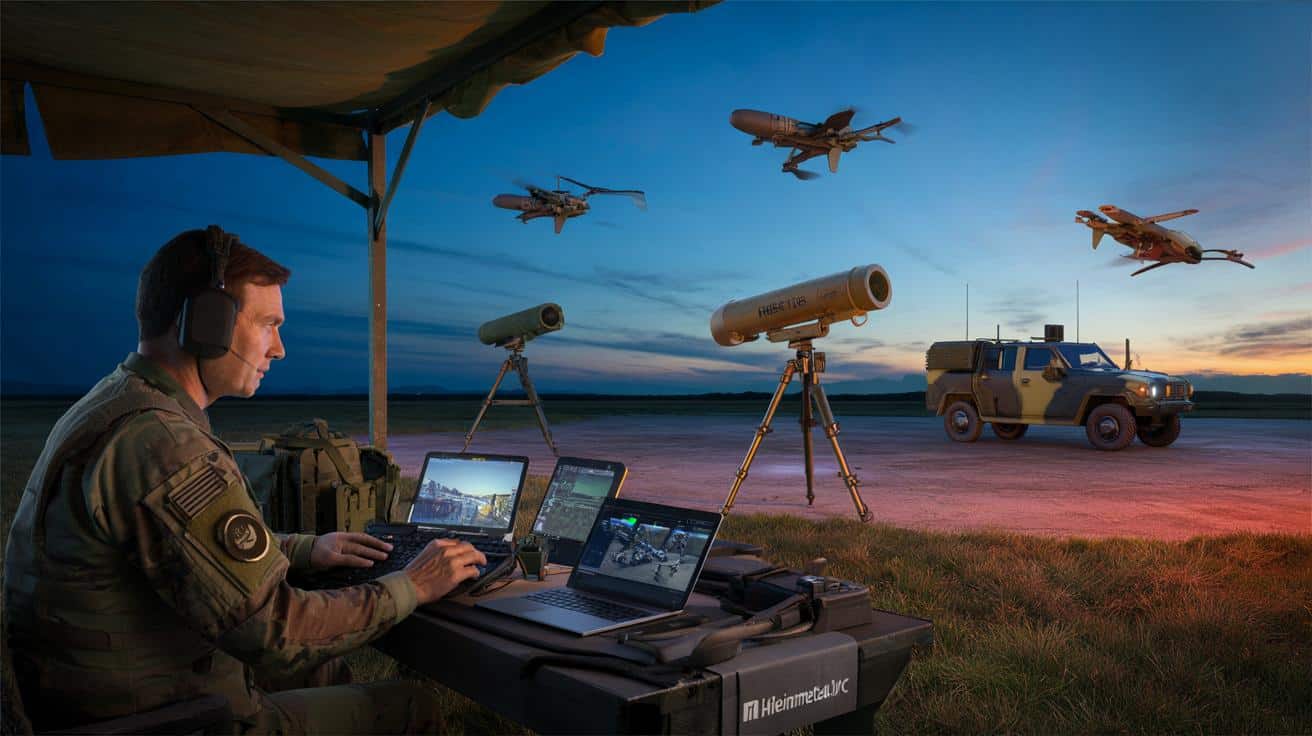
All HERO variants share a “man-in-the-loop” control philosophy, allowing the operator to steer, retarget or abort the strike right up to the last second.
This ongoing human control is central for NATO forces. It aligns with stricter rules of engagement, reduces the risk of hitting civilians or friendly forces, and offers political reassurance as debates about autonomous weapons grow louder.
➡️ MBDA Brings Its Thundart Rocket Out Of The Shadows For The French Army
➡️ US reviews plan that could place Greenland defense under total American control
➡️ Why these 8 fighter jets are seen as the ultimate weapons in the sky
➡️ U.S. Navy achieves first F-35B fighter jet landing on amphibious assault ship USS Kearsarge
➡️ Spain confirms order for 30 Turkish Hürjet training jets worth €2.6 billion
➡️ Germany orders 200 Puma IFVs with Spike anti-tank missiles for $4.9 billion
The three HERO variants ordered
HERO-30: the infantry’s pocket precision strike
The HERO-30 is the lightest of the three systems and is designed to be carried by small infantry units.
- Portable and man-packable by a single soldier
- Effective range of roughly 10 km
- Suited for soft targets such as sensors, firing positions and light vehicles
For infantry sections, HERO-30 effectively replaces the need to call in larger assets for small but hard-to-reach threats. A forward unit can launch a munition from behind cover, loiter over a ridge or urban block, wait for a target to appear and then strike.
HERO-120: designed to hunt armoured vehicles
The HERO-120 adds a larger warhead and increased range. It targets armoured vehicles, fortified positions and critical nodes such as communication hubs.
With its heavier charge, HERO-120 is closer to a guided anti-tank weapon that can search for and choose its angle of attack instead of flying in a straight line. That opens up ambush tactics against columns or temporary assembly areas.
HERO-400: deep strikes from the tactical edge
The HERO-400 sits at the top end of this order. It is larger, with longer endurance, and capable of hitting targets more than 100 km away, depending on the specific configuration.
| Variant | Main role | Typical targets | Approximate reach |
|---|---|---|---|
| HERO-30 | Light tactical support | Infantry positions, sensors, light vehicles | Around 10 km |
| HERO-120 | Anti-armour and fortified sites | Armoured vehicles, bunkers, key infrastructure | Beyond short tactical range |
| HERO-400 | Deep precision strike | Radars, command centres, logistics depots | Over 100 km in some configurations |
With systems like HERO-400, brigade and division commanders can plan attacks against high-value assets far behind the front line without risking crewed aircraft. That blurs the classic boundary between artillery, missiles and air strikes.
A new layer between artillery and air support
From an operational perspective, HERO munitions fill a gap that has long frustrated commanders. Classic artillery is fast and powerful but often lacks precision or real-time visual confirmation. Air support offers precision and flexibility but is scarce, expensive and weather-dependent.
Loitering munitions give tactical units the ability to watch an area, wait patiently for the right moment and strike, all without exposing troops directly.
Each launch also doubles as an intelligence mission. While circling, the munition sends live video and data back to command networks. Even if a strike is cancelled, the information gathered can feed into targeting databases and battlefield mapping.
This dual role—sensor and shooter—supports the broader NATO push towards “sensor-to-shooter” chains, where information collected by one asset can immediately trigger action by another.
Industrial and political stakes in Europe
Rheinmetall’s decision to ramp up production at RWM Italia has industrial and geopolitical weight. European states have watched with unease as many of the most widely used loitering munitions in Ukraine have come from outside Europe, especially from Israel and the US.
By building a strong manufacturing base in Italy, Rheinmetall and UVision position HERO as a European-accessible system with secure supply. For governments nervous about export restrictions or political shifts in supplier countries, that matters as much as the technical capabilities.
The contract also reflects a broader trend: NATO planners now talk openly about preparing for long wars of attrition, where stockpiles and production capacity may count more than individual platform sophistication.
The language used around the deal highlights volume: these are munitions to be counted in batches and pallets, not in one-off specialist purchases.
How “man-in-the-loop” actually works
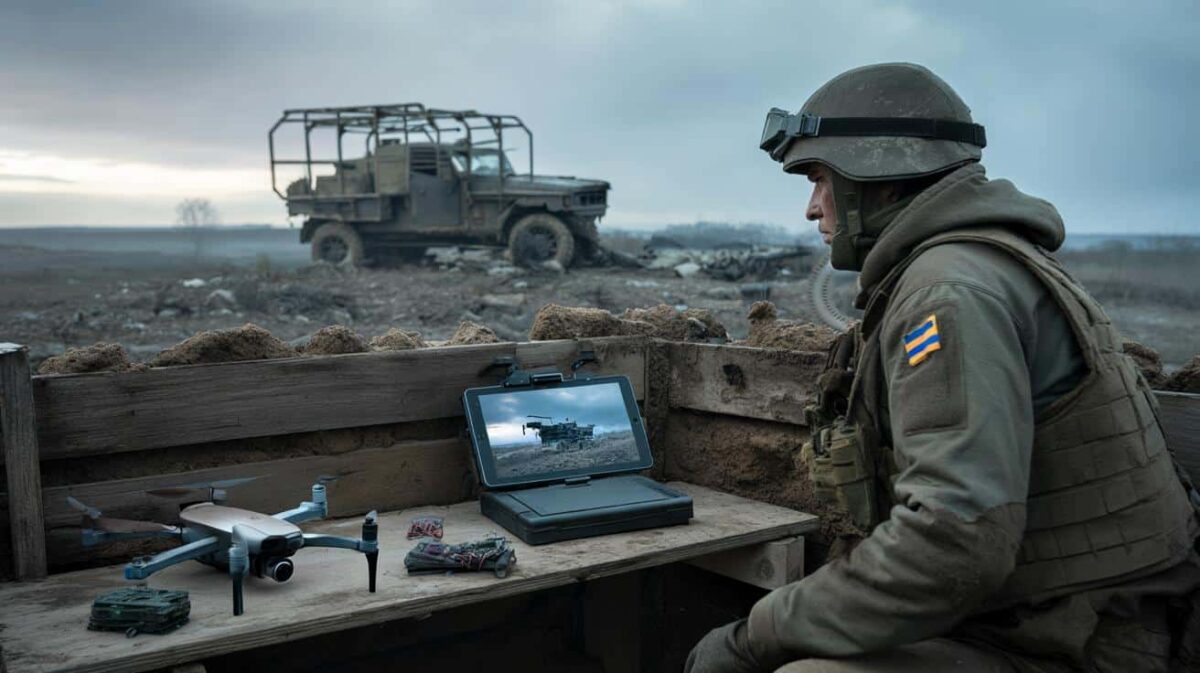
The phrase “man-in-the-loop” can sound abstract, but on the battlefield it comes down to a few simple functions. The operator, usually sitting behind a rugged tablet and control unit, can:
- Direct the munition’s flight path using waypoints or manual control
- Zoom in and out of live video to positively identify targets
- Switch to a different target if the situation changes
- Abort the strike and command the munition to self-destruct away from sensitive areas
From a legal and ethical standpoint, this continuous human involvement is seen as a safeguard, especially in crowded environments where military and civilian objects are mixed. It also reduces the risk of expensive munitions being wasted on low-value targets or decoys.
Risks, benefits and how usage might evolve
The spread of systems like HERO brings both advantages and risks. On the one hand, forces gain precise, responsive firepower that can reduce the need for carpet bombing or heavy barrages. On the other, any increase in long-range precision weapons can draw countermeasures such as jamming, decoy deployment and stronger air defence coverage.
Future scenarios often involve swarming tactics: multiple loitering munitions launched in quick succession to overwhelm defences. A battery might fire several HERO-30 and HERO-120 munitions at once, forcing an enemy to reveal radar positions or spend scarce interceptor missiles.
For civilians, the key question is how these systems affect the tempo and pattern of fighting. Because they allow forces to engage targets that were previously out of reach, they can both shorten some engagements and prolong campaigns by making it harder for combatants to hide and regroup safely.
One related area to watch is training. Effective use of man-in-the-loop systems depends on skilled operators who can read terrain, interpret video feeds quickly and make disciplined fire/no-fire decisions. Many armies are now creating specialist courses for loitering munitions, blending skills from artillery, drone piloting and intelligence analysis.