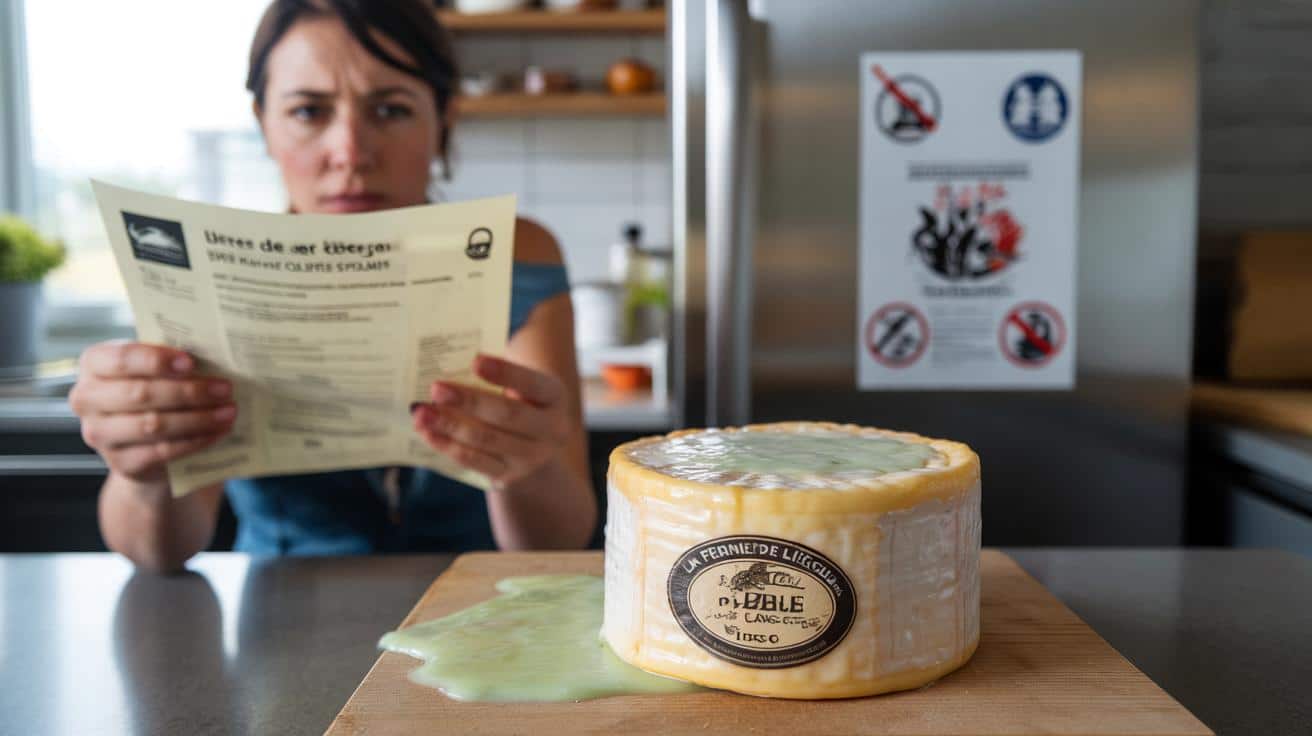
French food safety authorities have launched a nationwide recall for a popular goat’s cheese tomme, after tests showed bacterial contamination that can trigger serious illness, especially in vulnerable people. Shoppers who recently purchased this product are being urged to check labels carefully and stop eating it immediately.
Which goat’s cheese has been recalled?
The recall targets a specific farmhouse-style goat’s cheese sold across France, known as a “tommette” – a small, round tomme usually enjoyed sliced or baked.
This is a national recall of the “Bêêle des prés” goat’s milk tommette sold under the brand “La Ferme de Liègue”.
According to the official recall notice, the cheese was produced and distributed nationwide by La Ferme de Liègue, a French dairy operation specialising in goat’s milk products. The affected cheeses were sold between 5 December 2025 and 26 January 2026.
Unlike supermarket-branded cheeses, this one circulated mainly through specialist shops and independent retailers. The recall specifically mentions distribution via:
- Aumand
- Ouest Frais
- La boucherie du coin
- SAS du Bignon
- La Fée Cochette
- Olivier Jouteau
In stores, the product appeared as a small tomme labelled “Bêêle des prés”, wrapped and clearly marked with the brand “La Ferme de Liègue”.
How to recognise the affected cheese at home
If you have goat’s cheese in the fridge and are unsure whether it is included, you can verify the details printed on the packaging. The lots concerned carry the following batch numbers:
- CTB031125
- CTB041125
- CTB051125
- CTB291025
- CTB121125
- CTB191125
- CTB261125
- CTB281125
- CTB291125
The GTIN (barcode reference) is 3770026529294, and the recalled tommettes carry a use-by date of 11 March 2026.
| Product | Brand | Type | Sales period | Use-by date |
|---|---|---|---|---|
| “Bêêle des prés” tommette | La Ferme de Liègue | Goat’s milk cheese | 05/12/2025 – 26/01/2026 | 11/03/2026 |
If your cheese matches the brand, product name, batch number or GTIN listed, do not eat it.
➡️ MBDA Brings Its Thundart Rocket Out Of The Shadows For The French Army
➡️ “I’m a hairdresser and here’s my best advice for 50-year-old women who want short hair”
➡️ An ‘ingenious’ Ukrainian weapon so disruptive NATO fears it more than Russia does
➡️ U.S. Navy achieves first F-35B fighter jet landing on amphibious assault ship USS Kearsarge
➡️ Germany contracts Polaris to develop two-stage hypersonic test vehicle
What kind of contamination was found?
Tests on the recalled batches have detected contamination with Listeria monocytogenes, the bacterium responsible for listeriosis. This makes the cheese unfit to eat under French food safety rules.
Goat’s cheese, especially in its soft or semi-soft forms, can carry higher microbiological risks if hygiene slips at any point in the production chain. Here, inspectors flagged the presence of Listeria, prompting a national alert.
Health authorities stress that cooking does not always guarantee safety if the product has been heavily contaminated or mishandled. The clearest advice: treat this particular batch as unsafe and keep it off the table entirely.
What are the health risks of listeriosis?
Listeriosis is a foodborne infection that can begin with seemingly mild, flu-like symptoms. It can also lead to severe complications, particularly in high-risk groups.
Typical early signs include:
- Sudden or persistent fever
- Muscle aches and body pains
- Headache
- Occasionally digestive issues such as nausea or diarrhoea
Most healthy adults recover, sometimes without even realising that food was the source. The concern grows sharply for:
- Pregnant women
- Newborn babies
- Elderly people
- Anyone with a weakened immune system (due to illness, medication, or treatment like chemotherapy)
After eating a contaminated product, any fever or unusual symptoms should prompt an urgent call to a doctor.
In these vulnerable groups, listeriosis can spread beyond the digestive system and cause serious infections, including meningitis, blood poisoning and pregnancy complications.
What to do if you’ve eaten the recalled cheese
If you have already consumed the “Bêêle des prés” tommette from La Ferme de Liègue, do not panic, but stay alert.
- If you have no symptoms: there is usually no need for treatment, but you can mention the exposure to your GP if you are pregnant or immunocompromised.
- If you feel unwell: contact a healthcare professional, especially if you develop fever, aches or headache in the weeks following consumption.
Doctors may decide to carry out blood tests or start antibiotics depending on your health profile and symptoms.
What should consumers do with the cheese?
French authorities have set out a clear course of action for anyone holding the recalled product.
Stop eating the cheese, return it to the point of sale before 26 March 2026, and request a refund.
Consumers can obtain financial compensation by bringing the cheese back to the shop where it was purchased. The recall notice indicates a deadline of Thursday 26 March 2026 for returns and refunds.
Questions about the procedure can be directed to a dedicated contact number: 06 21 00 34 42 (French number). Staff should provide guidance on refunds and on safe handling if the cheese is still at home.
How to handle a recalled food product safely
If you still have the cheese in your fridge, avoid tasting “just to see” whether it seems normal. Listeria does not necessarily change the smell or flavour.
- Keep it wrapped to limit contamination of other foods.
- Place it in a sealed bag or box if you are transporting it back to the shop.
- Wash your hands, cutting boards and knives thoroughly after handling.
If you do not wish to return it, you can discard it in a closed bin bag. Washing the fridge shelf where it was stored with hot soapy water adds another layer of precaution.
Why goat’s cheese recalls hit a nerve in France
France is deeply attached to its cheeses, and goat’s cheese holds a special place. It is often seen as lighter and easier to digest than many cow’s milk cheeses. For many households, a small goat’s cheese is a weekly staple, served on bread or crumbled over salads.
Food safety alerts around artisanal-style cheeses can feel like an attack on tradition, yet they also show that monitoring systems are functioning. Regular microbiological checks are designed precisely to detect and remove risky products before serious outbreaks unfold.
France’s love affair with cheese coexists with strict safety controls designed to protect that very tradition.
Balancing taste and safety with soft cheeses
Soft and semi-soft cheeses, especially those made from raw milk, carry more microbiological risk than hard cheeses. That does not mean they should vanish from the table, but some groups are advised to be selective.
Health agencies in many countries suggest that pregnant women, older people, and immunocompromised patients avoid certain soft cheeses unless they are clearly labelled as made from pasteurised milk and handled under strict hygiene conditions.
In practice, that can mean:
- Checking labels for “pasteurised milk” if you are in a vulnerable group.
- Eating soft cheeses soon after purchase and keeping them well chilled.
- Avoiding cheeses that look excessively runny, have damaged packaging, or have been left at room temperature for hours.
Understanding listeria risk in everyday life
Listeria monocytogenes is found in soil, water and on plants. It can contaminate raw ingredients and survive in cold environments, which is why chilled foods such as soft cheeses, smoked fish and ready-to-eat meats are often under close surveillance.
A key point for consumers is that refrigeration slows the growth of Listeria but does not always stop it completely. Long storage times in the fridge, especially beyond the use-by date, can tip the balance from low risk to genuinely hazardous.
Thinking about a typical week in a household, an at-risk person might eat the recalled goat’s cheese in a salad on Monday, some leftovers on Wednesday, and still have a piece sitting in the fridge a week later. That kind of repeated exposure can raise the chance of infection, even if each bite seems harmless on its own.
Managing risk therefore comes down to a mix of actions: following recall notices, using food within recommended dates, and paying special attention when cooking for people who are more vulnerable. In that context, the current French recall is less an isolated scare and more a reminder that even beloved, high-quality products need constant monitoring and informed handling at home.