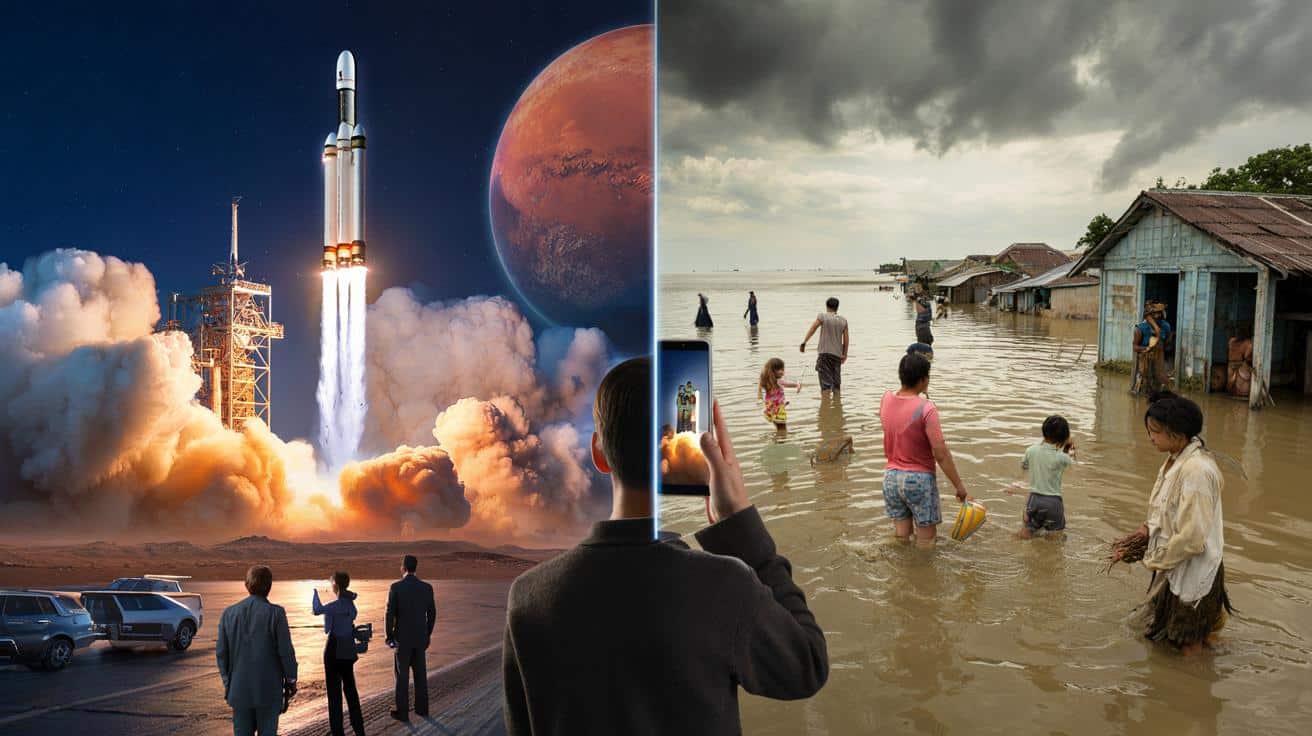
On one side of the screen, a rocket slices into the sky, trailing fire and billionaire dreams. On the other, a video shot on a phone: a family wading through waist‑high brown water in a village that no longer appears on any tourist map. You scroll, thumb hovering between awe and quiet dread. Is this humanity at its most brilliant, or most absurd?
The live stream chat roars with “Let’s go to Mars!” while the comments under the flood video say “Pray for us” and “We have nowhere to go.” Two worlds, one planet, one algorithm.
Some days it feels like the real war isn’t humans versus climate change.
It’s humans versus humans over what “saving the planet” even means.
Two futures loading at the same time
Stand in any big city café and you’ll hear it. At one table, friends excitedly debating the next SpaceX test flight. At another, someone quietly saying they’re scared their coastal hometown won’t exist in 20 years. The air is thick with both techno-optimism and exhaustion.
We talk about “the future” like it’s one big thing, waiting patiently ahead of us.
In reality, different futures are already colliding in the same moment.
Look at the numbers. While the world’s richest pour billions into reusable rockets and Martian habitats, the people paying the highest price for carbon emissions live far from launch pads. Pakistan’s catastrophic 2022 floods left a third of the country underwater and displaced more than 30 million people. The same year, a single US tech billionaire added several billion dollars to his net worth on the promise of off-world expansion.
No one live-streamed the slow loss of farmland, the ruined schoolbooks, the children coughing in overcrowded camps.
Those images don’t look futuristic enough for the front page.
This is where the war of narratives begins. One camp says, **we need a backup planet** because Earth is already broken by our own hands. Another argues that “multi-planetary species” talk is a distraction from fixing the systems that caused the damage in the first place. Both claim they’re trying to save humanity.
The tension hides in a plain question with no easy answer: who gets to decide what “saving” looks like?
The person booking a ticket to low‑Earth orbit, or the grandmother fighting to keep saltwater from eating her front door?
Small choices in a world of giant rockets
It’s tempting to throw up our hands and say, “This is all too big for me.” Rockets, UN summits, climate treaties, billionaires on magazine covers. Yet real change often starts in far less glamorous places. A city council meeting about flood defences. A neighbour‑run WhatsApp group to check on elderly residents during heatwaves. A worker in a factory quietly pushing for cleaner processes.
➡️ Even in winter, you can sprout sweet potatoes for spring
➡️ MBDA Brings Its Thundart Rocket Out Of The Shadows For The French Army
➡️ Rheinmetall receives major order for HERO loitering munitions
➡️ Nationwide recall in France after goat’s cheese contaminated with bacteria
➡️ Heating: the 19°C rule is over, here is the experts’ recommendation
➡️ This simple winter gesture promises hydrangeas covered in flowers by spring
Think of it like a noisy group chat.
You can’t control every message, but you can decide which ones you respond to and amplify.
Climate action has become weirdly performative. One person posts their perfectly sorted recycling and another replies with a screenshot of a private jet tracker. Both have a point, and both can miss the deeper story. What actually shifts things is when personal gestures connect to structural pressure. A coastal community documenting rising water lines, then presenting that data to journalists and local officials. Young voters tying their ballot directly to flood insurance, air quality, or heat protections for workers.
Let’s be honest: nobody really does this every single day.
Still, the days when we do lean in have a way of setting cracks in very old walls.
We spoke to a climate researcher in Dakar, who told me quietly: “We don’t want a ticket to Mars. We want a chance to stay where our grandparents are buried.” That sentence lingers longer than any flashy launch.
- Follow money, not just headlines: which projects in your region get funded – sea walls or spaceports?
- Ask rude questions: who benefits from “green” branding, and who is still losing their home?
- Support boring heroes: local planners, flood engineers, building inspectors, nurses in heatwaves.
- Use your feed strategically: one shared story from a flooded town can travel further than you think.
- *Remember that survival isn’t just oxygen and food; it’s language, memory, and the right to stay put.*
Who gets to belong to the future?
There’s a plain truth we rarely say out loud: **the future is already unevenly distributed**. For someone in Rotterdam or Tokyo, “climate adaptation” might mean better pumps and higher dykes. For someone in Tuvalu or Bangladesh, it can mean the slow erasure of their entire country. The Mars conversation drops into that reality like a stone into a flooded street.
When you’re told your land will be underwater by 2050, hearing about luxury space tourism feels less like progress and more like abandonment.
At the same time, not all space dreams are evil, and not all climate action is pure. There are scientists using satellite data to track illegal deforestation. Engineers designing cleaner fuels originally meant for rockets that end up reducing emissions on Earth. There are also fossil fuel companies wrapping themselves in green slogans while lobbying quietly against regulation. The lines blur fast.
We’ve all been there, that moment when you realise the story you’ve been sold doesn’t match the lives you see around you.
That gap is where cynicism grows – or where new movements begin.
The quiet question underneath the Mars race is: who is humanity, exactly? The word sounds universal, but policies are specific. Passport numbers, skin tones, postcodes. When billionaires talk about safeguarding “human civilisation” on a new planet, people in flood‑prone slums hear something else: survival for the few, souvenirs for the rest.
Some activists argue that the most radical act right now is not to leave, but to stay. To fight for a livable Earth rather than a high‑tech lifeboat. Others insist both paths can coexist, that a species capable of building rockets can also build justice. Both sides are tired. Both are afraid.
And both are right to feel that time is slipping between their fingers.
A planet arguing with itself in real time
Walk through a supermarket chilled aisle during a heatwave and you can feel the paradox humming. Air‑conditioned comfort powered by the same grids that fuel the storms. Advertisements promising “eco‑friendly” everything while news alerts warn of another record‑breaking summer. We live in this strange split screen where apocalypse and marketing share the same fluorescent light.
There is no referee blowing the whistle on which version of “saving the planet” wins.
There is only us, arguing, improvising, messing up, trying again.
The war isn’t just between rich and poor nations, or between climate activists and tech billionaires. It’s inside families where one sibling works in fossil fuels and another campaigns against pipelines. Inside our own heads when we book a cheap flight and then donate to a flood relief fund. Inside cities that proudly paint bike lanes on their streets while approving new airport runways.
*Maybe the most honest place to stand is right in that contradiction, eyes open, no easy villains.*
From there, questions land differently: not “Mars or Earth?” but “Who gets to feel safe, and when?”
So the rockets will keep flying, and the seas will keep rising for a while yet. Some people will keep dreaming of domes on red dust, others of stronger houses on threatened coasts. Between those visions, there’s a third path starting to flicker: not escape, not denial, but a messy, shared negotiation over what kind of future counts as a win.
That negotiation isn’t happening in pristine conference halls alone. It’s in flooded classrooms, rooftop gardens, late‑night group chats, and, yes, in your scrolling thumb hovering over what to watch next. The algorithms can’t decide whose version of “saving the planet” is right.
We will – whether we like that responsibility or not.
| Key point | Detail | Value for the reader |
|---|---|---|
| Clashing futures | Space colonisation and climate survival are unfolding at the same time, often for different groups of people. | Helps you see headlines about rockets and floods as part of the same story, not separate worlds. |
| Power and narrative | Who controls money and media often shapes what “saving humanity” is supposed to look like. | Gives you a lens to question whose interests are really being protected in big promises. |
| Everyday leverage | Local action, voting, and what you amplify online can quietly influence which future gets funded. | Shows where your personal influence actually lives, beyond guilt and doomscrolling. |
FAQ:
- Is going to Mars actually bad for the climate fight?Not automatically, but it can be a distraction when sold as a clean escape hatch. Some space tech helps Earth (satellites for climate data, cleaner fuels), yet the political story around Mars can undermine urgency for fixing things here.
- Why do poor countries suffer most from climate change?They’ve historically emitted far fewer greenhouse gases, yet sit in more vulnerable regions and lack expensive protections like sea walls, strong infrastructure, and robust safety nets.
- Does my individual action really matter?On its own, one gesture is small. Combined with millions of others and tied to political pressure, consumer choices, and public storytelling, it becomes part of a much larger push that leaders can’t easily ignore.
- Are all billionaires ignoring climate justice?No. Some invest in renewables, adaptation tech, and loss-and-damage funds. The tension is that their power can still sidestep democratic debate about which communities are prioritised.
- What’s one simple way to “pick a side” in this quiet war?Pay attention to who is already on the front lines where you live – flood‑hit communities, heat‑exposed workers, organisers – and back their demands, not just their tragedies, with your voice, vote, and wallet.