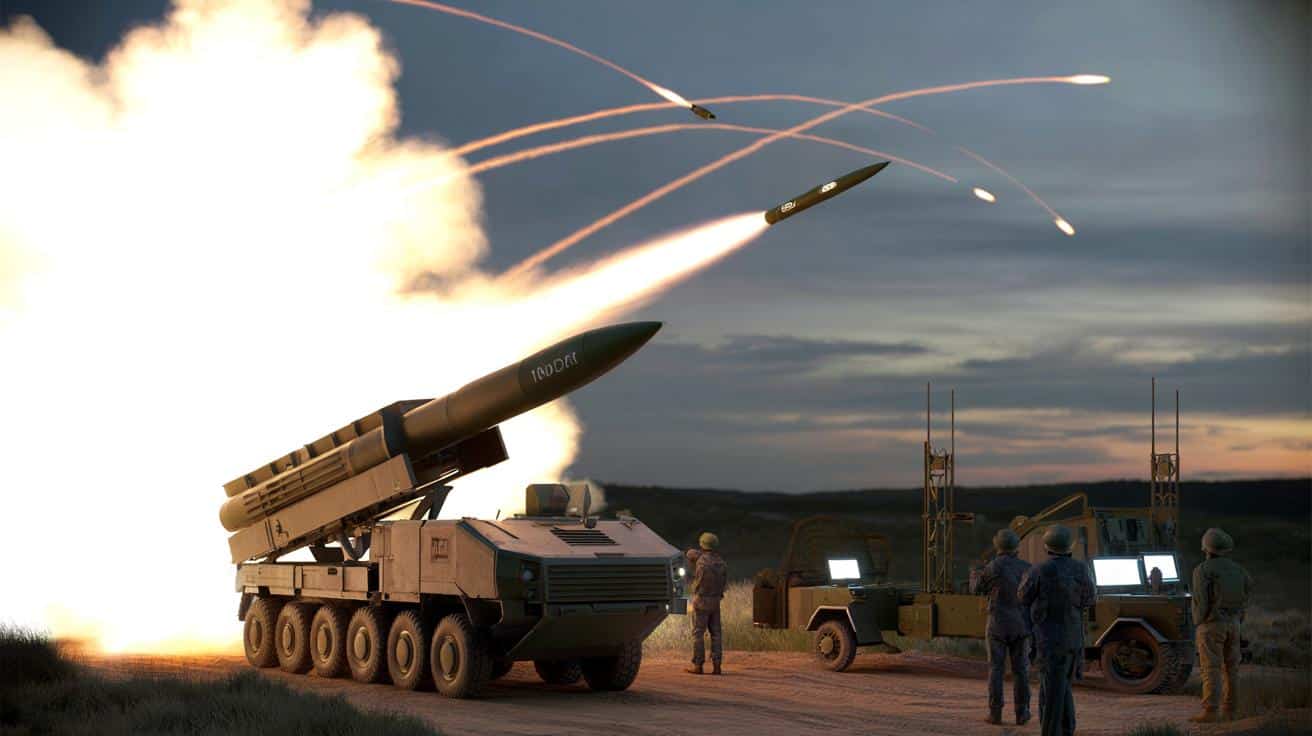
The European missile group MBDA used Saint Barbara’s Day, patron saint of artillerymen, to unveil Thundart, a new guided rocket that could redefine how the French Army strikes deep behind enemy lines.
Thundart steps into the spotlight
Until this week, Thundart existed mostly in rumours and internal briefings. Then MBDA posted a photo on X, showing for the first time its 227 mm guided rocket, designed for long-range ground fire.
The timing was not accidental. France’s current heavy rocket launchers, the Lance-Roquettes Unitaire (LRU), are nearing the end of their service life. These systems, based on the US M270, can hit targets out to about 70 km. That range increasingly looks short on battlefields shaped by drones, counter-battery radars and long-range precision strikes.
Thundart is pitched as the next step: a guided rocket able to hit at roughly 150 km, with much tighter accuracy than existing systems.
The new weapon sits at the centre of France’s “Frappe Longue Portée Terrestre” (FLP-T) programme, the long-range land strike effort run by the French defence procurement agency, the DGA.
A high-stakes duel inside the French industry
FLP-T has created an unusual industrial face-off. On one side: MBDA, Europe’s leading missile house, partnered with Safran for navigation and optronics. On the other: ArianeGroup, better known for space launchers, teamed up with Thales.
The DGA plans a test campaign running until mid-2026. After that, the French Ministry of Armed Forces will pick a winner. The stakes go well beyond a single rocket contract. The decision will signal how far France intends to go in preserving independent long-range strike capability, rather than relying on foreign systems.
MBDA and Safran are pushing a fully French solution, designed and built in France, without US-regulated components. In defence jargon, they are promising an “ITAR-free” product, not constrained by American export controls.
The choice will pit a sovereign but still maturing product against off-the-shelf foreign launchers that can be bought and fielded more quickly.
➡️ Even in winter, you can sprout sweet potatoes for spring
➡️ U.S. Navy achieves first F-35B fighter jet landing on amphibious assault ship USS Kearsarge
➡️ Spain confirms order for 30 Turkish Hürjet training jets worth €2.6 billion
➡️ An ‘ingenious’ Ukrainian weapon so disruptive NATO fears it more than Russia does
➡️ Why these 8 fighter jets are seen as the ultimate weapons in the sky
How Thundart aims to stand out
On paper, Thundart’s numbers aim to change the game for the French Army:
- Calibre: 227 mm guided rocket
- Range: about 150 km, more than double current LRU reach
- Intended role: long-range precision fire against high-value targets
The rocket’s guidance architecture doesn’t start from scratch. MBDA has dipped into existing technology, especially from French air-to-ground weapons such as the AASM/HAMMER family.
| Guidance component | Function |
|---|---|
| Inertial navigation | Keeps the rocket on course using internal sensors, even if GPS is disrupted |
| GPS | Provides accurate position updates and helps achieve high-precision impact |
| Infrared seeker (optional) | Allows homing on heat signatures, useful in poor weather or at night |
| Laser guidance (optional) | Enables engagement of moving or fleeting targets designated by a laser spot |
By transplanting these “bricks” from air-launched munitions to ground-launched rockets, MBDA hopes to reduce technical risk and compress development timelines.
Extending range without rewriting doctrine
For French artillery units, MBDA’s promise is continuity rather than revolution. Thundart is meant to plug into systems soldiers already know, instead of imposing new command chains and software.
The fire-control system would be derived from that of the CAESAr self-propelled howitzer. Thundart should also integrate with ATLAS, the French digital artillery command and control network that links sensors, decision-makers and guns.
The idea is simple: keep the same digital backbone and operating habits, but stretch the reach of the guns far beyond today’s limits.
This approach matters for training and operations. Maintaining familiar procedures reduces the time needed to bring new weapons into real combat readiness. It also helps avoid accidental fires or friendly fire incidents that can come with overly complex changes in doctrine.
Facing HIMARS, PULS and Chunmoo
While France debates its long-range future, foreign launchers are already making headlines on active battlefields. The US HIMARS system has become a symbol of precision strikes in Ukraine. Israel’s PULS and South Korea’s Chunmoo have also won export contracts across Europe and Asia.
These systems offer something very attractive to governments: they exist, they work, and they can be delivered relatively fast. For a French army under pressure to modernise after observing the wars in Ukraine and the Middle East, time is a serious factor.
Choosing Thundart would mean continuing to invest in national skills and industrial capacity, with potentially higher export prospects later. Opting for a foreign launcher might give the Army capability sooner but with more dependence on outside suppliers for ammunition, upgrades and data standards.
Why long-range rockets are back in fashion
Long-range artillery, once overshadowed by aircraft and cruise missiles, is back at the centre of strategic thinking. Several trends explain this:
- GPS-guided rockets can hit strategic targets at a fraction of the cost of a missile strike.
- They can be fired from concealed, mobile launchers, then move before enemy counter-strikes.
- They complicate an adversary’s planning, forcing them to disperse and harden logistics hubs, headquarters and air defences.
- They are less politically sensitive than using manned aircraft over contested skies.
In this context, Thundart is not just another rocket. It is part of the French response to a global race in long-range fires, where rockets, missiles, drones and loitering munitions overlap in roles and ranges.
Possible use cases on a modern battlefield
Military planners are likely sketching out several scenarios for Thundart:
On a high-intensity front, a battery of Thundart launchers could strike ammunition depots or command posts 120 km away. A forward observer or surveillance drone could illuminate a moving convoy with a laser, allowing a guided rocket to adjust its path in the final seconds before impact.
In a crisis involving a near-peer adversary, Thundart could be used on the first day of operations to disrupt air defence radars and logistics nodes, opening gaps for manned aircraft or cruise missiles to exploit. Its extended range would let French units remain on national territory or a secure rear area while still hitting deep targets.
Key terms that shape the debate
For non-specialists, a few concepts help frame what is at stake with Thundart and similar programmes:
- ITAR-free: A weapon built without US-controlled components, allowing the exporting nation to approve sales without Washington’s consent. This gives more flexibility but can limit access to some advanced technologies.
- Long-range fires: A broad category covering rockets, missiles, and sometimes heavy artillery that strike beyond traditional front-line ranges, often targeting support structures deep in enemy territory.
- Guided rocket vs. missile: Rockets like Thundart are typically simpler and cheaper, with no complex propulsion stages after launch. Missiles often include more advanced propulsion and guidance, at higher cost but with increased range or manoeuvrability.
The balance between these factors – autonomy, cost, speed of delivery, export potential – will shape not just Thundart’s future, but France’s position among countries able to offer credible long-range strike systems to allies.
For now, Thundart has just stepped out of the shadows with a single photo. The real test will come on French ranges in the next two years, under the eyes of engineers, artillery officers and political leaders who all know that long-range rockets are no longer a niche capability, but a core element of modern war planning.