The Spanish government has confirmed a multibillion-euro contract for a new generation of jet trainers, turning to an unexpected partner and sidelining a previously promoted homegrown project.
Spain turns to Turkey’s Hürjet instead of a domestic trainer
Back in 2020, Airbus floated the idea of a new Spanish-designed jet trainer, the Airbus Future Jet Trainer (AFJT), meant to replace ageing F-5M Tiger aircraft used for advanced fighter training. That project never passed the drawing-board phase for Madrid’s Ministry of Defence.
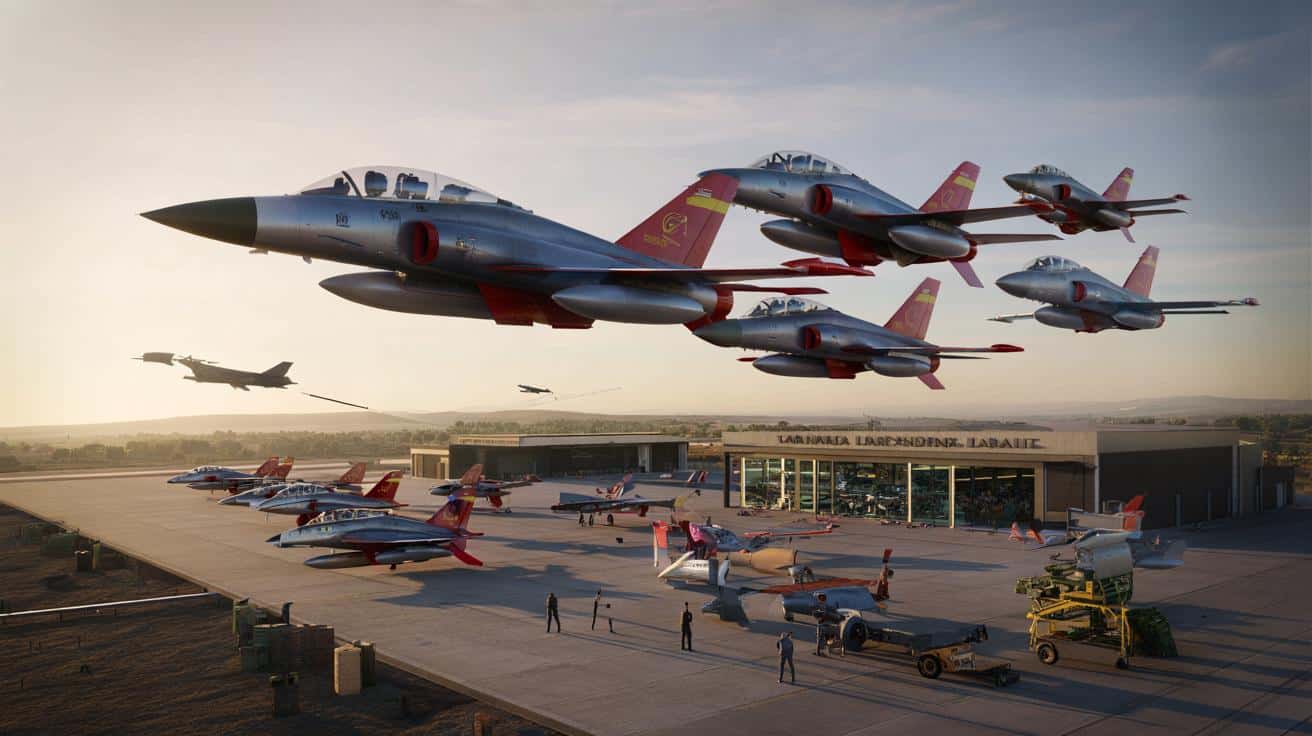
Instead, four years on, Spain has committed to the Hürjet, a Turkish-designed advanced jet trainer developed by Turkish Aerospace Industries (TAI). The choice reflects both budgetary realities and the rapid emergence of Turkey as a defence supplier within NATO.
Spain has signed a €2.6 billion contract for 30 Hürjet aircraft and a full advanced training ecosystem built around them.
The deal was quietly prepared through a protocol agreement signed between Spain and Turkey’s defence industries authority, which aimed to build an “advanced training system” based on the Hürjet platform.
A €2.6 billion package that goes far beyond the jets
On 29 December, Spain’s Directorate General of Armament and Material officially confirmed the order. The contract, worth €2.6 billion, was awarded to Airbus Defence and Space, acting as national coordinator, and TAI as the aircraft manufacturer.
This is not a simple off-the-shelf purchase. The programme encompasses several major elements designed to anchor the capability in Spain.
- Purchase of 30 Hürjet advanced jet trainers
- Adaptation of the aircraft to Spanish “national standard”
- Creation of an aircraft conversion centre in Spain
- Modernisation of the fighter school at Talavera la Real air base
- Provision of an integrated operations and maintenance support package
The Hürjet deal is as much about building an integrated combat training system in Spain as it is about buying airplanes.
Airbus will lead a consortium of Spanish companies — including names such as ITP Aero, Inra and Senet — to develop what is described as an Integrated Training System for Combat (ITS‑C). That includes simulators, mission planning tools, and data-driven training environments tied directly to the jets themselves.
➡️ Even in winter, you can sprout sweet potatoes for spring
➡️ US reviews plan that could place Greenland defense under total American control
➡️ Rheinmetall receives major order for HERO loitering munitions
➡️ Germany contracts Polaris to develop two-stage hypersonic test vehicle
➡️ This simple winter gesture promises hydrangeas covered in flowers by spring
➡️ Nationwide recall in France after goat’s cheese contaminated with bacteria
Timeline: from first deliveries to full operational service
The Hürjet rollout in Spain will happen in two phases, stretching over most of the next decade.
| Phase | Period | Main milestones |
|---|---|---|
| Initial delivery | 2028–2029 | Hürjet delivered in initial configuration to Spain |
| Local adaptation | 2031–2035 | Airbus modifies aircraft to Spanish requirements; full entry into service at Talavera la Real |
During the first phase, the aircraft arrive in their baseline configuration from Turkey. In the second phase, Airbus will integrate Spanish-specific systems, software and mission equipment. The jets will then be progressively based at Talavera la Real in western Spain, home of the Spanish fighter pilot school.
The long schedule underlines how complex modern training programmes have become. It is not only about flying hours, but about building a tightly connected system that mirrors the avionics, data flows and mission profiles of front-line fighters.
A first for a Turkish-designed combat aircraft in the EU and NATO
One aspect of the deal stands out in Brussels and Washington: outside of drones, this is the first time a European Union and NATO member state has bought a Turkish-designed military aircraft.
The Hürjet order marks a symbolic breakthrough for Turkey’s defence industry inside the EU and NATO market.
Turkey has already exported its Bayraktar drones across Europe and beyond, but manned combat aircraft are another level of strategic trust and technical cooperation. The Spanish deal may encourage other NATO air forces looking to replace ageing trainers to add the Hürjet to their shortlist.
For Ankara, the contract is a political and industrial win, showing that its industry can integrate into complex Western defence ecosystems. For Madrid, the choice reflects a balance between cost, performance and schedule, while still ensuring strong Spanish industrial participation via Airbus.
How Hürjet fits into Spain’s pilot training pipeline
Spain’s air and space force (Ejército del Aire y del Espacio) already runs a tiered training system. Basic and intermediate training are conducted on Pilatus PC‑21 turboprop aircraft, the same model used by the French Air and Space Force.
Where Spain parts ways with France is at the advanced stage. France has shifted away from jet trainers for the transition from training aircraft to Rafale fighters, relying heavily on simulators and modern turboprops. Spain has decided to keep a dedicated jet stage.
Hürjet will bridge the gap between the PC‑21 and Spain’s front-line fighters, such as the Eurofighter Typhoon and the future FCAS aircraft.
The new jets will allow Spanish instructors to rehearse high-speed intercepts, complex air combat manoeuvres and modern sensor management with student pilots before they move onto combat aircraft, reducing the learning curve and costs on the more expensive platforms.
Industrial and strategic benefits for Spain
Airbus defends the programme as a way to keep advanced aerospace skills and jobs on Spanish soil. The creation of a conversion centre and a renewed training campus at Talavera la Real will require engineers, technicians and instructors for decades.
Jean‑Brice Dumont, head of the Air Power division at Airbus Defence and Space, described the programme as designed to provide cutting-edge training, boost national industrial participation and secure Spanish sovereignty across the project lifecycle.
That notion of “sovereignty” runs through Madrid’s approach to defence procurement. By placing Airbus as national coordinator, Spain keeps control over integration work, data flows, and future upgrades, even though the airframe itself is Turkish.
What makes an advanced jet trainer different from a basic trainer?
For non-specialists, the distinction between a turboprop trainer and a jet trainer can be confusing. Both train pilots, but they do not do the same job.
- Basic trainers (like the PC‑21) teach core flying skills, instrument flight and basic tactics at relatively low cost.
- Advanced jet trainers simulate the performance and cockpit environment of modern fighters, including high speed, high G‑loads and complex avionics.
Hürjet falls into the second category. It is designed to mimic many of the flight characteristics and sensor workloads of front-line aircraft while staying cheaper to operate. That includes digital cockpits, data links and mission computers that can be configured to resemble those of the Typhoon or, in future, the Franco‑German‑Spanish Future Combat Air System (FCAS).
Future scenarios and potential ripple effects
If the Hürjet programme runs on schedule and meets expectations, Spain could leverage the new training system in several ways. One scenario often mentioned in defence circles is using spare capacity to train pilots from other friendly countries, turning Talavera la Real into a regional training hub.
Another possibility is incremental upgrades. Once the industrial infrastructure is in place, Spain could decide to integrate additional sensors or weapons on some Hürjet aircraft, turning a portion of the fleet into light attack or aggressor platforms for training purposes. That would be cheaper than using front-line fighters for such roles.
There are also risks. Long schedules and multi-country integration programmes can face delays, cost overruns or software challenges. Aligning Turkish and European certification standards, managing sensitive technologies and keeping the aircraft fully interoperable inside NATO networks will require tight coordination between Ankara, Madrid and Airbus.
For readers following broader defence trends, the Hürjet deal highlights a growing mix-and-match approach in European air forces. Instead of relying solely on domestic designs, states are combining aircraft, simulators, data systems and foreign platforms to build tailored training pipelines. The Spanish choice signals that Turkish kit, once considered peripheral, is now part of that menu.