The German government has quietly taken a major step into hypersonic flight, hiring Munich-based start-up Polaris Spaceplanes to build and test a reusable two-stage vehicle that can operate both in the atmosphere and on the edge of space.
Germany’s hypersonic bet takes shape
The project, known as the Hypersonic Test and Experimentation Vehicle (HYTEV), gives Germany a dedicated platform to trial cutting-edge technologies at extreme speeds. The concept work ran from 2024 to 2025, and the first full system is planned to be ready for flight tests by the end of 2027.
HYTEV is designed as a reusable flying laboratory for hypersonic research, with an option to act as a compact spaceplane for defence and reconnaissance.
According to Polaris, the contract marks a rare step for Europe. The company says it is not aware of any similar system ordered from a private entity on the continent, underlining how unusual it is for a start-up to take on such an ambitious test vehicle for a national military customer.
The primary customer is the Bundeswehr, Germany’s armed forces, which has shown growing interest in hypersonic systems as major powers race to develop faster and more manoeuvrable missiles, aircraft and sensors.
How the two-stage vehicle will work
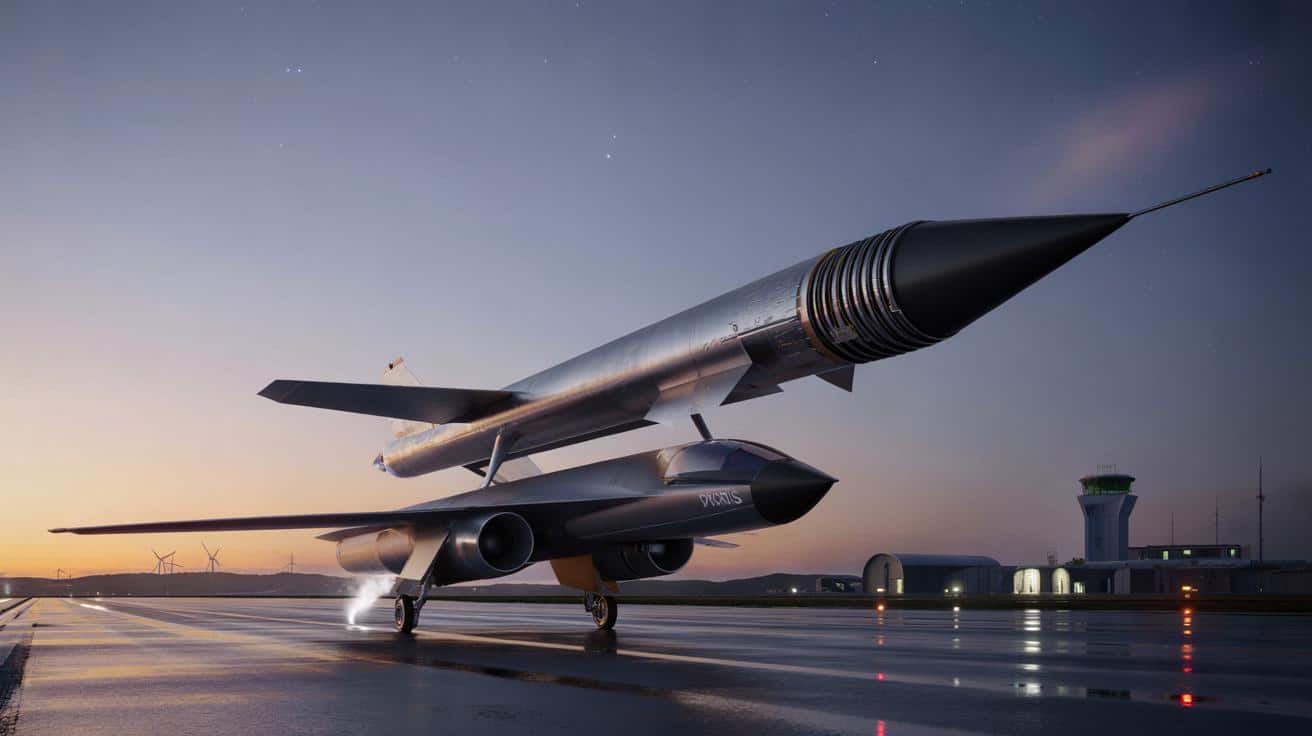
HYTEV is conceived as a horizontally launched, horizontally landing system, closer in operations to an aircraft than a traditional rocket. The lower stage uses a pair of turbofan engines, allowing it to take off from a runway, climb and cruise like a conventional jet.
Once in the right flight corridor, the upper stage ignites its rocket engines and accelerates to hypersonic speeds before separating. This staging approach reduces the need for large launch pads and heavy booster rockets.
Key features of the HYTEV concept
- Horizontal takeoff and landing from standard runways
- Turbofan-powered carrier stage for flexible operations
- Rocket-powered upper stage for hypersonic flight and space access
- Reusable design aimed at multiple missions and test campaigns
- Payload capacity up to around 1,000 kg to low-Earth orbit
Polaris says the overall size and takeoff mass are roughly comparable to a modern fighter jet, which makes the vehicle relatively compact by space-launch standards. At the same time, the upper stage can be fitted either as a pure experimental platform or as a small satellite launcher.
The upper stage doubles as both hypersonic testbed and micro-launch vehicle, bridging aviation and space access in a single system.
➡️ Rheinmetall receives major order for HERO loitering munitions
➡️ Why these 8 fighter jets are seen as the ultimate weapons in the sky
➡️ “I’m a hairdresser and here’s my best advice for 50-year-old women who want short hair”
➡️ US Space Command Taps SpaceX for Missile Warning, Tracking Satellites
This dual-role potential is central to HYTEV’s value: the same architecture that tests new heat shields or guidance software at Mach 5+ can, in a different configuration, place a small payload into orbit.
Testbed today, reconnaissance spaceplane tomorrow
While the primary focus is research, German planners clearly have other uses in mind. Officially, HYTEV will serve defence-related, scientific and institutional users, providing flight conditions that ground facilities and conventional jets cannot match.
In a secondary role, the reusable vehicle could act as a spaceplane for above-atmosphere reconnaissance. That might include rapid imaging of crisis zones, electronic intelligence missions over contested regions, or technology demonstrations for future space-based surveillance systems.
The horizontal launch profile offers one more advantage: sorties could, in theory, be flown from multiple airfields. That brings flexibility and complicates the task of any potential adversary trying to track launch preparations.
Why hypersonic research matters for Germany
Germany is not alone in chasing hypersonic capabilities, but its approach leans heavily towards testing and verification rather than rapid weapon deployment. HYTEV can support:
- Aerothermal experiments on how materials behave at extreme heating
- Navigation, guidance and control testing at high dynamic pressures
- Communication systems that must work through ionised air around a vehicle
- Reusability studies to cut long-term operating costs
- Payload tests ranging from sensors to scientific instruments
Because the system is reusable, data from one mission can be quickly fed back into design tweaks for the next, giving German researchers an iterative test cycle instead of relying only on expensive one-off shots.
Polaris’s hypersonic engine work in the background
HYTEV does not start from scratch. Polaris has already been developing a key piece of propulsion hardware: a linear aerospike rocket engine, designated AS-1. This engine type, long discussed in aerospace circles but rarely flown, is known for maintaining high efficiency across a wide range of altitudes.
Polaris has already achieved in-flight ignition of its AS-1 aerospike engine, a rare milestone for a young European spaceplane company.
In 2023, the company won a contract to produce this engine for a spaceplane demonstrator. By 2024, AS-1 had completed in-flight ignition trials, proving it can start reliably in real aerospace conditions, not just on a test stand.
Since then, Polaris has used two small demonstrators, MIRA II and MIRA III, to push the engine and airframe technologies forward. These scaled vehicles have been under testing for more than a year and have already hit several campaign milestones, such as stable powered flight segments and repeated recoveries.
From MIRA demonstrators to a fully fledged test vehicle
The MIRA series acts as a stepping stone between pure laboratory work and the far more demanding HYTEV system. Engineers can check how the aerospike behaves during ascent and descent, how guidance software handles aerodynamic transitions, and how landing procedures work when a rocket-powered vehicle operates like an aircraft.
That mix of rocket and aircraft behaviour is at the heart of HYTEV’s challenge. The lower stage must be efficient and reliable in the dense lower atmosphere, while the upper stage must shrug off brutal heating and thin air at the edge of space.
| Program | Role | Status |
|---|---|---|
| MIRA II / MIRA III | Small-scale demonstrators, engine and flight testing | Ongoing testing, several milestones reached |
| AS-1 engine | Linear aerospike rocket propulsion | In-flight ignition achieved, further development underway |
| HYTEV | Two-stage hypersonic test and experimental vehicle | Concept matured 2024–2025, flight-ready goal by end of 2027 |
What “hypersonic” really means in practice
Hypersonic speeds start at around Mach 5, five times the speed of sound. At these velocities the air around a vehicle compresses and heats up intensely, creating a sheath of hot, sometimes ionised gas.
This brings several engineering headaches. The structure must tolerate surface temperatures that can exceed 1,000°C on leading edges. Control surfaces need to work in highly disturbed airflow. Radio links can briefly cut out as the ionised layer interferes with signals.
For HYTEV, that means test campaigns will likely examine thermal protection tiles, advanced composite materials, and active cooling techniques, as well as software designed to keep the vehicle controllable in harsh, changing conditions.
Potential scenarios and risks around HYTEV operations
Once operational, HYTEV flights could follow several patterns. One short mission profile might take off from a German air base, climb on turbofan power, ignite its rocket upper stage to reach hypersonic speeds along a suborbital arc, then glide back for landing. A different profile could send the upper stage slightly higher and faster, releasing a small satellite into low-Earth orbit before returning.
Each mission carries technical and political risks. On the technical side, any failure at high speed can quickly become catastrophic if control is lost. That pushes Polaris and the Bundeswehr to build in redundant systems, robust abort modes and carefully staged test envelopes.
Politically, hypersonic technologies often raise concerns among neighbouring states and arms-control advocates. While HYTEV is framed as a test and experimentation platform, some observers will watch closely for signs that data from the programme feeds into offensive missile projects.
Why this matters beyond Germany’s borders
For Europe’s aerospace sector, HYTEV could signal a shift towards more agile, commercial-style development of advanced flight systems. A smaller company taking the lead, rather than a large state-owned contractor, might accelerate innovation and lower costs for hypersonic testing in the region.
If the programme hits its 2027 readiness target, European research institutions, NATO partners and commercial payload operators might gain access to a reusable hypersonic testbed that previously did not exist on their doorstep. That could affect how future aircraft, missiles, satellite launchers and even climate research sensors are designed and certified for extreme conditions.