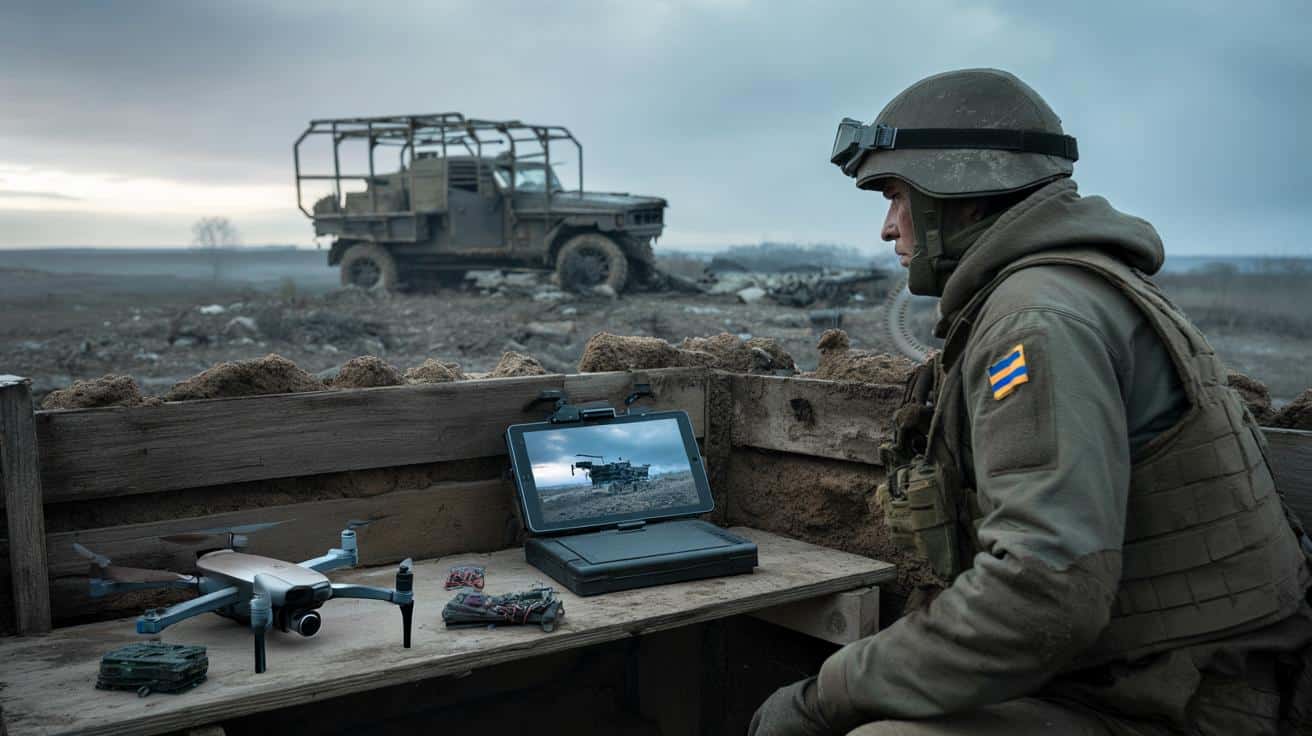
On a gray morning near Kherson, the sky looks empty at first glance. No roaring jets, no missile trails. Just low clouds and a few nervous birds. Then a tiny buzz creeps in from somewhere above the treeline, so faint a nearby generator almost drowns it out. A Ukrainian soldier in a damp trench doesn’t even look up. He only checks the tablet strapped to his chest and mutters, “Ours,” with a tired half-smile.
On his screen, a cheap-looking icon moves across a Google-style map. That dot is the most disruptive weapon in the war right now. A weapon cobbled together from hobby drones, 3D‑printed parts and $50 cameras.
And this is the part that secretly keeps NATO planners awake at night.
The DIY weapon that rewrote the battlefield rules
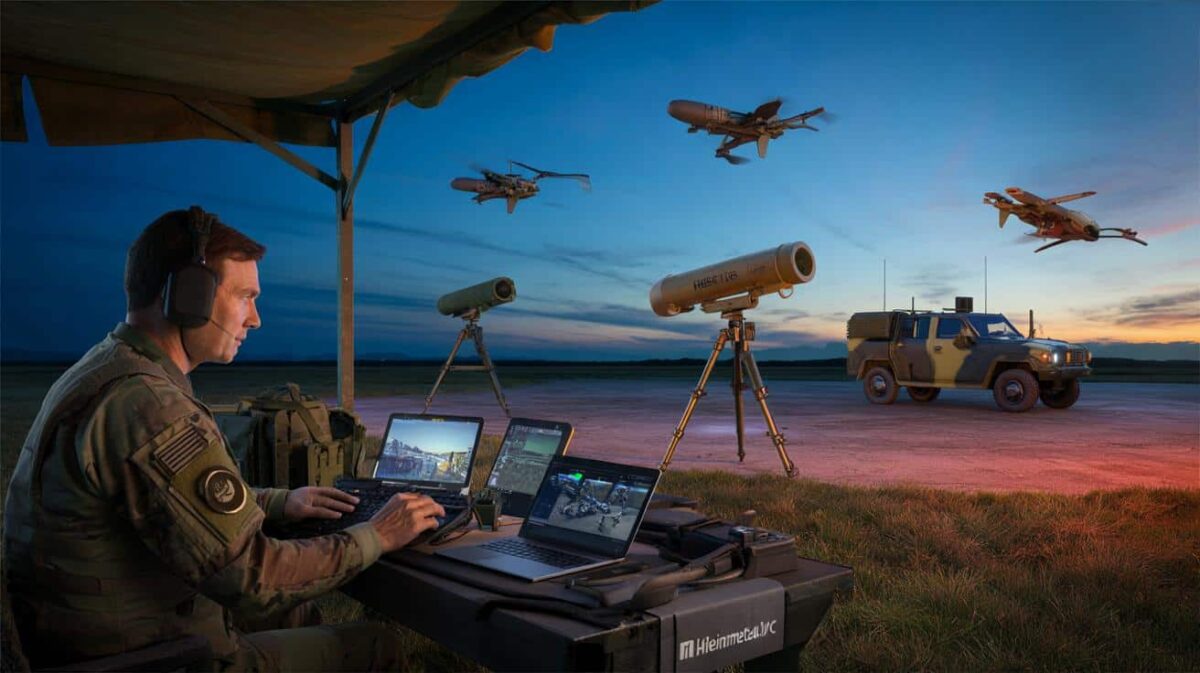
Ukraine’s “ingenious” weapon is not a single gadget, but an entire swarm of low-cost, first‑person‑view kamikaze drones and homemade strike systems that behave like a thinking organism. Built in apartment kitchens and converted garages, then refined in secret workshops, these drones stalk Russian armor, trenches and even radar antennas with unnerving precision. One operator sits miles away, wearing cheap gaming goggles, flying a bomb straight into a tank hatch as easily as someone playing a racing game.
On Telegram, the footage looks like shaky GoPro clips. On NATO briefing slides, it looks like the end of comfortable air superiority.
Take the story that Ukrainian drone unit commander “Molfar” told local reporters. His team started in 2022 with four commercial quadcopters bought online and batteries that barely held a charge in the winter cold. They lost three drones in two weeks. The fourth, rebuilt with 3D‑printed mounts and a jury‑rigged explosives cradle, destroyed a Russian armored vehicle worth more than a million dollars.
Today, that same unit runs dozens of FPV kamikaze drones daily. They cost roughly $400 a piece, including explosives. Last autumn, during a single night near Robotyne, they reportedly disabled seven Russian vehicles and a rare electronic warfare station, all guided from cramped basements with patchy Starlink connections.
The math is brutal. A Western missile can cost hundreds of thousands of dollars; a modern tank, several million. A field‑made Ukrainian drone can be built for the price of a decent smartphone and flown by a 22‑year‑old volunteer who learned on YouTube. One drone, one trench. One drone, one self‑propelled gun. The old logic of war — spend big to win big — suddenly looks clumsy.
That’s why NATO officers visiting the front often seem fascinated and uneasy at the same time. They’re not just seeing a new weapon. They’re watching their entire procurement system being quietly mocked by a box of Chinese electronics and a spool of PLA filament.
Why NATO fears it more than Russia does
On the Russian side, the fear is immediate and physical. Crews sleep with their boots on because the whine of a drone can mean you have four seconds to run. Tank commanders ride “buttoned up” under cages welded from scrap metal, hoping the lattice will deflect a top‑attack FPV. Russian telegram channels are full of curses about “Banderite drones” and blurry night-vision videos of last‑second evasive maneuvers.
➡️ Even in winter, you can sprout sweet potatoes for spring
➡️ This simple winter gesture promises hydrangeas covered in flowers by spring
➡️ U.S. Navy achieves first F-35B fighter jet landing on amphibious assault ship USS Kearsarge
➡️ US reviews plan that could place Greenland defense under total American control
➡️ Rheinmetall receives major order for HERO loitering munitions
➡️ Nationwide recall in France after goat’s cheese contaminated with bacteria
For NATO, the dread is quieter, more strategic. Officers see a future where the sky is permanently buzzing with cheap, lethal robots. And they know their own armies are slow, expensive, and wired for a different era.
There’s a telling scene that plays out again and again when Western delegations visit Ukrainian drone schools. On one side, Ukrainian instructors in mismatched uniforms, tattoos poking from under hoodies, proudly display racks of custom FPV drones, each slightly different, each adapted after last week’s battle. On the other side, visiting colonels from Europe and North America glance at them, then at each other.
They’re used to billion‑euro programs, five‑year test cycles, dozens of signatures before a new antenna is allowed on a vehicle. Here, a teenager with a soldering iron is pushing nightly firmware updates straight to the front line. No glossy brochure, no PowerPoint. Just: “We lost two drones to jamming this week, so we changed the code.”
That’s the real disruption. Not just that Ukraine’s drones are deadly, but that the whole process behind them moves at internet speed. NATO armies are discovering they’re optimized for buying F‑35s, not for a war where $300 devices define who can move during daylight. A single artillery gun spotted by a quadcopter might be targeted within minutes; a convoy that once felt safe at night is now lit up by thermal cameras welded onto off‑the‑shelf frames.
*Let’s be honest: nobody really rewires a 30‑year‑old bureaucracy overnight, no matter how many urgent memos get written in Brussels.* That’s why, quietly, some NATO planners admit they fear this Ukrainian revolution almost as much as their Russian counterparts do — because it exposes how slow and fragile their own systems have become.
Inside the “garage labs” changing modern warfare
On the outskirts of Kyiv, hidden behind a car wash and a nail salon, there’s a building with blacked‑out windows and a permanent smell of burnt plastic. Inside, young engineers sit hunched over cluttered workbenches: laptops open, coffee cups everywhere, propellers and circuit boards scattered like Lego. This is one of dozens of semi‑official drone labs that have sprung up across Ukraine.
Their method is deceptively simple. Test at the front, tweak at night, print new parts by morning. Rinse, repeat. A broken antenna becomes a redesigned mount. A Russian jammer knocks drones from the sky, so the software team rewrites the control link and sends an updated firmware file over Signal.
It’s easy to romanticize this, but the process stumbles all the time. Designs fail. Batteries swell in the cold. A promising long‑range prototype falls out of the sky five minutes after launch. Some volunteer teams drown in Telegram messages and donations they can’t manage. Others burn out completely from stress and grief.
We’ve all been there, that moment when improvisation turns into chaos and you realize you need at least a bit of structure. The Ukrainian drone world is no different. The best units learned the hard way that “move fast and break things” doesn’t work when “things” are people and they’re dying.
Over the past year, the ecosystem quietly matured. The army formalized entire drone brigades. Certain designs — like standardized FPV frames and “bomber” quadcopters — became semi‑official. Procurement channels were set up, even if they still run partly on personal trust and encrypted chats. One drone instructor in Dnipro summed it up to a visiting journalist with a shrug:
“We’re somewhere between a startup and a trench. The West is afraid of that, I think. Because you can’t put this into a neat NATO manual.”
From that strange middle ground came a few unwritten rules:
- Iterate based on real combat feedback, not theoretical doctrine.
- Buy or build the cheapest thing that reliably kills expensive targets.
- Accept a 30–40% loss rate if the cost exchange is still wildly in your favor.
- Train operators fast, then let them suggest design changes.
- Expect the enemy to adapt within weeks, not years.
What this “ingenious” shift means for everyone else
The uncomfortable truth is that this isn’t just Ukraine’s war story. It’s a preview. A world where any mid‑sized military — or well-funded militia — can field swarms of semi‑disposable aerial weapons built from the same supply chains that stock online gadget stores. A world where your expensive tank, your half‑billion‑euro frigate, even your quiet logistics convoy suddenly look like oversized targets to a teenager with a headset and a backpack full of batteries.
For NATO, the fear isn’t that Ukraine has invented something they can’t copy. The fear is that copying it means admitting their old assumptions are broken.
Right now, Western capitals are racing to adapt. They’re buying drone jammers, funding “loitering munition” startups, launching innovation challenges with fancy names. Some are quietly sending their own engineers to sit with Ukrainian drone units and just watch, notebook in hand. At the same time, defense giants lobby to fold this new chaos back into familiar structures: long contracts, big platforms, tidy lines on a spreadsheet.
On the front lines, none of that feels abstract. A Ukrainian soldier points at a cheap FPV drone charging on a wooden shelf and says, simply, “This thing saves my life, or ends theirs. That’s it.” The geopolitics fit around that reality, not the other way around.
So the “ingenious Ukrainian weapon” that NATO secretly fears is not just flying over Russian trenches. It’s already hovering over military budgets in Paris, Berlin, Washington. It’s buzzing through think‑tank papers and late‑night staff meetings where someone finally says out loud: “Our enemies can do this too.”
In a few years, when we talk about this war, we might not remember the model numbers of these drones or the acronyms for the jammers built to stop them. We’ll remember that this was the conflict where the garage, the gaming chair, and the 3D printer quietly ambushed the tank, the jet, and the general staff. And that once everyone had seen it work, there was no going back.
| Key point | Detail | Value for the reader |
|---|---|---|
| Cheap drones vs. expensive hardware | Ukrainian FPV and DIY drones destroy armored vehicles and systems worth millions at a fraction of the cost | Helps you grasp why this “low‑budget” tech is shaking entire defense doctrines |
| Startup mindset in wartime | Front‑line feedback, rapid iteration, and garage labs outpace traditional procurement cycles | Shows how agility can beat size, in war as in business or policy |
| NATO’s strategic anxiety | Adopting these methods means admitting older, slower systems no longer fit modern drone‑saturated battlefields | Gives context for future headlines about defense spending, new tech, and shifting military priorities |
FAQ:
- What exactly is this “ingenious” Ukrainian weapon?
It’s less a single device and more an ecosystem of low‑cost FPV kamikaze drones, modified commercial quadcopters, and rapidly iterated DIY strike systems that work together as a flexible, lethal network.- Why would NATO fear it more than Russia?
Russia fears the immediate destruction on the battlefield. NATO fears what it reveals about its own slow, expensive procurement systems and the vulnerability of high‑value platforms to very cheap, agile threats.- Are these drones really built in garages and apartments?
Yes. Many started exactly that way, with volunteers, 3D printers, and repurposed hobby parts. Over time, some of these efforts have been absorbed into more formal military structures, but the culture and speed of a “garage lab” remain.- Can Western armies just copy Ukraine’s approach?
They can copy the technology fairly easily. The harder part is copying the mindset: accepting high attrition, empowering low‑rank innovators, and shortening approval chains that have been entrenched for decades.- Does this change anything for ordinary civilians?
It likely will. Expect more debates about drone regulation, military spending, and how easy access to dual‑use tech blurs the line between civilian gadgets and battlefield weapons — far beyond Ukraine.