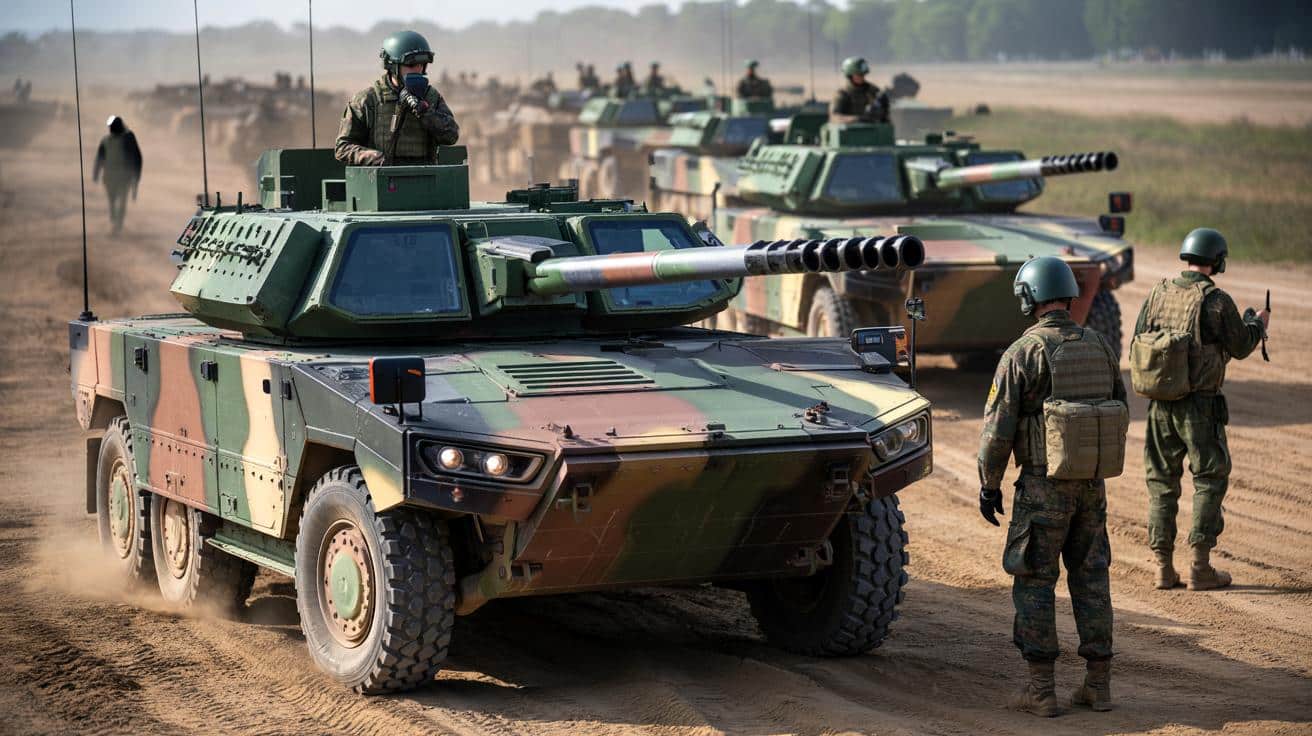
The government in Berlin has signed a multibillion-dollar deal for a new batch of infantry fighting vehicles, aiming to harden its ground forces and sharpen their long‑range punch with advanced anti-tank missiles.
Germany’s $4.9 billion bet on heavy armour
The German defence ministry has approved a 4.2‑billion‑euro ($4.92‑billion) contract for 200 Puma infantry fighting vehicles (IFVs). The deal goes to a joint venture between Rheinmetall and KNDS Deutschland, two of the country’s biggest land systems manufacturers.
The new order expands Germany’s Puma fleet while folding in long‑range Spike anti-tank missiles as standard equipment.
Deliveries are scheduled to begin in mid‑2028. That timeline reflects not only industrial lead times but also the need to align the new vehicles with Germany’s broader modernisation of its armoured brigades.
The acquisition sits within Berlin’s larger effort to rebuild military capability after decades of underinvestment. Part of the government’s 100‑billion‑euro special defence fund is being steered into ground forces, not just air and naval assets.
Why the Puma IFV matters to the Bundeswehr
The Puma is the core tracked fighting vehicle for Germany’s mechanised infantry. It is designed to move soldiers under armour, keep up with battle tanks, and engage a mix of armoured and soft targets.
Each Puma carries a crew of three — commander, gunner, and driver — plus six fully equipped infantry soldiers in the rear compartment. This creates a small, self-contained squad able to dismount and fight on foot once delivered to the frontline.
The vehicle is built around a modular armour system. Extra protection packages can be bolted on for high-threat missions or removed when lower weight and mobility take priority. That flexibility allows operators to tailor the vehicle to specific environments, from urban streets to open terrain.
Designed for networked warfare, the Puma links sensors, weapons and troops into Germany’s digital command systems.
➡️ MBDA Brings Its Thundart Rocket Out Of The Shadows For The French Army
➡️ The Swedish Saab says it is ready to work with Airbus to develop a new fighter jet
➡️ An ‘ingenious’ Ukrainian weapon so disruptive NATO fears it more than Russia does
➡️ Heating: the 19°C rule is over, here is the experts’ recommendation
Digital architecture is a key selling point. The Puma is meant to operate as part of an integrated battle network, sharing target data, video feeds and positional information in real time with other vehicles and headquarters.
Link to ongoing Puma upgrades
Germany is not starting from scratch with the Puma. Between 2023 and 2024, the Bundeswehr launched a comprehensive modernisation programme for 297 existing vehicles, due to finish by 2029.
This upgrade package includes:
- High-resolution day‑ and night‑vision camera systems for enhanced situational awareness
- Integration of the Spike LR anti-tank guided missile system
- Modern digital radio equipment for secure data and voice communications
The new batch of 200 vehicles will slot into this architecture, giving Germany a sizeable fleet of similarly equipped, digitally compatible IFVs in the next decade.
Spike anti-tank missiles: extending the Puma’s reach
A major element of the contract is the integration of the MELLS system, the German/European name for Rafael’s Spike LR family of anti-tank guided missiles.
| Missile type | Approximate range | Key feature |
|---|---|---|
| Spike LR | Up to 4 km | Fire-and-forget / fire-and-update guidance |
| Spike LR2 | Up to 5.5 km | Improved warhead and extended range |
The missiles are produced by a joint venture between Israel’s Rafael and German firms Diehl and Rheinmetall. That structure keeps a good share of the value and technical know‑how inside Germany while leveraging foreign design experience.
Spike LR missiles can hit targets up to around 4 kilometres away. The newer Spike LR2 version stretches that engagement envelope to roughly 5.5 kilometres and introduces a tandem high-explosive anti-tank (HEAT) warhead designed to penetrate modern composite and reactive armour.
With Spike, a Puma crew can strike tanks and fortified positions beyond direct line of sight, staying hidden while they engage.
The missile is versatile as well. It can be used against heavy armour, lighter vehicles, small naval targets and hardened bunkers. It also offers modes tailored for urban operations, including detonations within buildings against fighters using cover inside concrete structures.
Beyond visual range and survivability
Integrating MELLS onto the Puma changes how the vehicle can fight. Instead of relying mainly on its cannon and staying within sight of enemy armour, the crew gains the ability to launch missiles from concealed positions.
Shooting at extended range reduces exposure to enemy fire. Crews can use terrain features, smoke, or buildings as cover, launch a missile, and then reposition before the target can respond effectively.
This stand‑off capability becomes especially relevant against modern main battle tanks equipped with powerful guns and advanced sensors. If the first side to detect the other often wins, extending engagement range and using indirect approaches gives the Puma an advantage.
Industrial and strategic angles for Germany
The contract reinforces the position of Rheinmetall and KNDS Deutschland as pillars of the German and European defence industry. Production of the 200 vehicles will keep assembly lines busy well into the 2030s, supporting skilled jobs and preserving expertise in heavy armoured vehicle design.
The order also signals that Berlin intends to remain a framework nation inside NATO for land operations, not just a logistics hub or training base. By fielding a large, modern fleet of IFVs, Germany can anchor multinational brigades on its territory and across eastern Europe if required.
For allies, a strengthened German armoured force helps close some of the capability gaps revealed by the war in Ukraine, where artillery, armour and anti-tank weapons have again proved decisive.
How the Puma–Spike combo plays on today’s battlefield
Recent conflicts have shown that armoured vehicles without strong sensors and long-range precision weapons are at serious risk. Drones, loitering munitions and portable anti-tank missiles have multiplied the threats facing any tracked vehicle.
By pairing a protected, sensor‑rich IFV with a missile that hits targets several kilometres away, Germany aims to keep its infantry fighting vehicles relevant in a contested environment.
The Puma’s design reflects a shift from brute-force armour alone to a mix of protection, networking, and precision firepower.
In a likely combat scenario, Puma units would work alongside Leopard 2 tanks, artillery, and reconnaissance drones. Drones could spot enemy armour or fortified positions, pass coordinates digitally to the Puma, and the crew could launch a Spike missile without ever seeing the target directly through their own optics.
This sort of teaming demands robust communications and training but offers a way to reduce losses and increase the odds of a first-round hit.
Key terms and concepts explained
Infantry fighting vehicle (IFV): An IFV is an armoured vehicle that transports infantry into battle and supports them with onboard weapons. It is more heavily armed than a simple armoured personnel carrier and typically carries autocannons, machine guns, and sometimes anti-tank missiles.
Tandem HEAT warhead: This type of warhead uses two charges in sequence. The first charge defeats explosive reactive armour on the outside of a tank. The second, larger charge then strikes the main armour. That two‑stage design allows missiles like Spike LR2 to penetrate protection that would stop older weapons.
Beyond visual range (BVR): BVR engagements involve hitting a target at distances where the operator cannot see it with the naked eye or basic optics. Guided missiles and targeting data from other platforms make such attacks possible.
Risks, costs and potential future developments
Big armoured vehicle programmes carry risks. Delays, cost overruns or technical issues can erode political support. The Puma has already faced criticism in Germany after earlier technical problems and high maintenance demands, including reported breakdowns during some training exercises.
The new order raises expectations that those issues will be addressed. Reliability, spare parts supply, and user-friendly maintenance will matter as much as cutting‑edge sensors and missiles. If the vehicles are too complex to keep in the field, the investment loses much of its value.
There is also the question of how Puma fits alongside lighter, wheeled vehicles and unmanned systems. Armies across NATO are experimenting with integrating drones, robotic ground vehicles and remote weapon stations. Over time, the Puma platform could serve as a “mothership” for small unmanned systems, launching drones directly from the vehicle for reconnaissance or strike missions.
For now, though, Germany’s deal for 200 Puma IFVs armed with Spike missiles signals a clear choice: heavy armour, long‑range precision, and networked command systems remain central to how Berlin expects to fight, and deter, on a rapidly changing European battlefield.