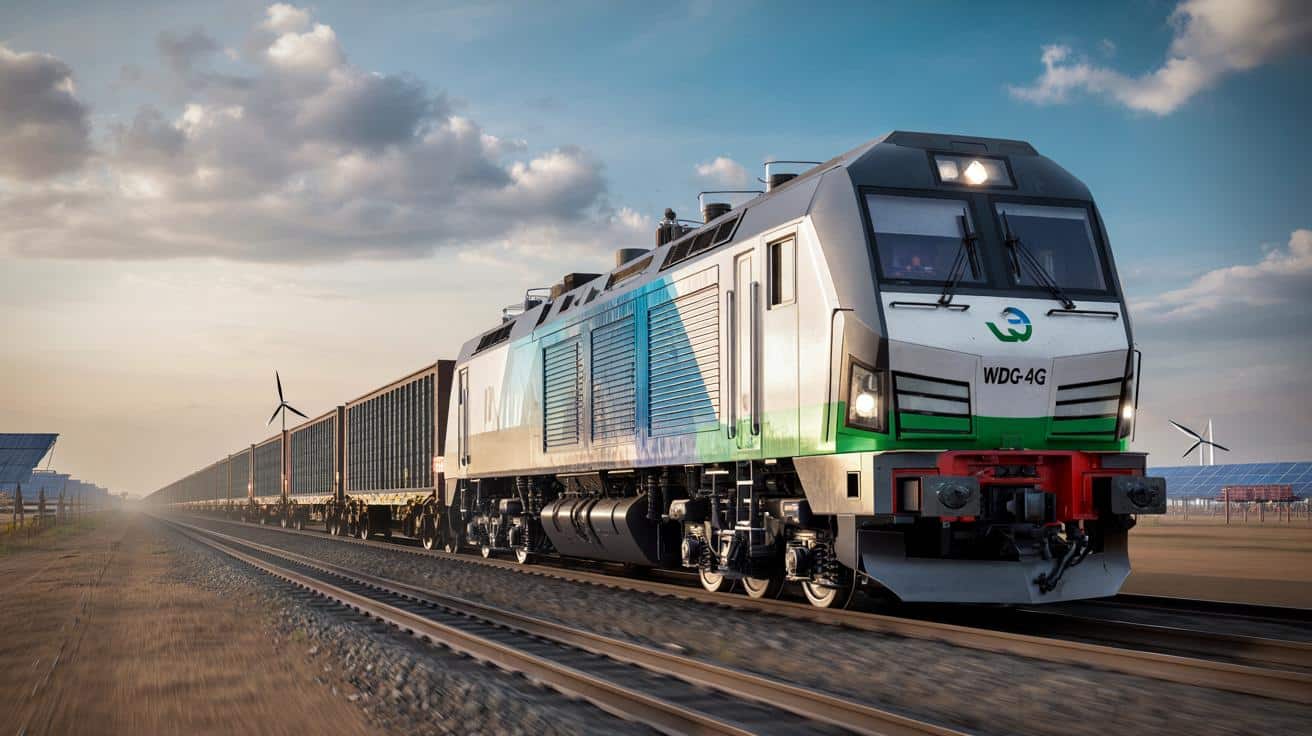
India has quietly rolled out a freight locomotive that does something no other train has done before: pair hydrogen power and batteries at a scale big enough to pull serious cargo and unsettle the diesel status quo.
India’s 3,100 hp hydrogen gamble
At the heart of the move is a single, eye-catching figure: 3,100 horsepower. That is the rated power of India’s new hydrogen locomotive, rebuilt from a conventional diesel engine and now billed as the most powerful hydrogen-powered loco in operation worldwide.
The project is led by Concord Control Systems Limited, which has signed a deal worth around €4.6 million with energy group NTPC Limited. Instead of designing a shiny, brand-new train, engineers are gutting an existing freight locomotive and refitting it with hydrogen tanks, fuel cells and batteries.
By doubling the previous global benchmark of around 1,600 horsepower, India pushes hydrogen rail from modest regional services into the heavy freight league.
Up to now, hydrogen trains have mostly been small-scale. Europe has tested quiet, low-emission multiple units on regional lines. Demonstrators have run in Germany, France and the UK, but generally with limited power and modest range.
India’s 3,100 hp machine changes that story. It targets long, heavy freight rather than light passenger shuttles, placing hydrogen side by side with diesel on a route where cost, endurance and ruggedness matter more than comfort.
China in the rear-view mirror
The political subtext is hard to miss. India has spent years watching China dominate headlines on high-speed and futuristic projects, from 450 km/h trains to hyperloop-style test tracks. Now New Delhi wants a clear victory in a different race: low-carbon heavy rail.
Beating Chinese and European hydrogen locomotives on raw power gives India a headline-grabbing record, but also a potential export card. The country is positioning itself as the supplier of “tomorrow’s train” not just for domestic use, but for regions where China is already very active: Africa, the Middle East and parts of Asia-Pacific.
This hydrogen locomotive isn’t just a prototype for India; it is a calling card aimed at governments still dependent on diesel for long-distance freight.
➡️ Heating: the 19°C rule is over, here is the experts’ recommendation
➡️ Rheinmetall receives major order for HERO loitering munitions
➡️ “I’m a hairdresser and here’s my best advice for 50-year-old women who want short hair”
➡️ MBDA Brings Its Thundart Rocket Out Of The Shadows For The French Army
➡️ An ‘ingenious’ Ukrainian weapon so disruptive NATO fears it more than Russia does
An energy–rail alliance built for scale
How the partnership is structured
The project sits at the crossroads of two powerful sectors. On one side is India’s massive railway operator; on the other, its state-backed energy machine.
- Advance Rail Controls Pvt. Ltd. and Railway Engineering Works handle the technical integration on the locomotive.
- NTPC Limited drives the hydrogen strategy, from production to refuelling infrastructure.
- Indian Railways provides the network, freight traffic and operational data to test the concept at scale.
The shared vision is simple: use renewable electricity to make hydrogen, then deploy that hydrogen where overhead wires are missing or too costly to install. Freight corridors, isolated lines and busy marshalling yards fall squarely into that category.
India already electrifies tracks at a rapid pace. Yet thousands of kilometres will remain diesel territory for years. Converting those corridors to hydrogen-powered freight trains opens a lower-cost, lower-carbon path than stringing catenary across vast, remote landscapes.
Hydrogen plus batteries, not one or the other
The locomotive uses a hybrid layout. Hydrogen fuel cells provide a steady flow of energy, while large batteries handle rapid power swings.
That combination delivers several benefits:
- Peak power on demand: Batteries supply bursts of extra power during acceleration or on steep gradients.
- Regenerative braking: When the train slows, traction motors feed energy back into the batteries instead of wasting it as heat.
- Smaller fuel cell stack: Because batteries handle the spikes, the fuel cell system does not need to be oversized.
- Smoother operation: Power output is more stable, reducing stress on components and improving efficiency.
The chassis chosen for conversion, similar to India’s heavy-freight WDG-4G, already supports high axle loads. That gives engineers enough space and weight allowance to add hydrogen tanks, batteries and fuel cells without crippling performance.
A freight message to the rest of the globe
Why 3,100 horsepower matters
The power rating is not arbitrary. Around 3,100 hp covers a very wide slice of typical freight operations, especially on non-electrified routes with mixed gradients. If the locomotive performs well in real traffic, the same blueprint could be adapted to many countries with similar freight patterns.
Regions that stand out include:
- Africa: Extensive diesel networks serving mines and ports, limited electrification.
- Middle East: Long desert corridors where installing and maintaining overhead lines is expensive.
- Australia: Heavy-haul ore and grain trains running for hundreds of kilometres away from major grids.
For states wrestling with expensive diesel imports, a hydrogen locomotive powered by local solar or wind could become both an energy and industrial policy tool.
Switching to overhead electrification in such regions often carries billion-euro price tags and long construction timelines. Rolling out hydrogen locomotives, supported by a handful of strategically located production and refuelling hubs, can be much faster, especially when backed by cheap renewables.
A showcase for India’s decarbonisation strategy
Indian Railways by the numbers
Few rail networks on the planet operate at India’s scale. Recent figures underline the pressure it faces:
| Main indicator | Key figure (2025–2026) |
| Network length | 69,000+ km |
| Daily passengers | 23 million (around 7 billion per year) |
| Annual freight (tonne-km) | 1.6 billion |
| Employees | 1.2 million |
| Broad-gauge electrification | 99% |
| New track per day | 15 km |
| Stations | 7,300+ |
| 2030 freight target | 3 billion tonnes |
On top of that, India is pushing ahead with a 2,843 km network of Dedicated Freight Corridors, almost completed, which should nearly double rail freight volumes. A high-speed line between Mumbai and Ahmedabad is under construction, with first sections expected later in the decade. Metro systems are expanding rapidly across more than 20 cities.
Within this surge of concrete and steel, a 3,100 hp hydrogen locomotive looks less like a flashy gadget and more like a missing piece of a larger decarbonisation puzzle. Indian Railways has set itself an aggressive target: carbon neutrality by 2030, decades earlier than national climate pledges originally suggested.
Hydrogen beyond buses and cars
Hydrogen has been talked up for years as a clean fuel for buses, trucks and even aircraft. Many projects have stayed stuck at pilot phase, raising doubts about real demand. NTPC sees the heavy rail sector as one of the most convincing early users.
Running a powerful freight locomotive on hydrogen proves that the gas is not confined to lightweight vehicles or niche demonstrators. It can tackle energy-hungry tasks, the very ones that burn the most diesel today.
Each tonne of diesel removed from a freight corridor cuts emissions sharply and reduces India’s reliance on imported fuel, a strategic priority as much as a climate measure.
A wider race to clean up heavy machinery
India’s move comes as large industrial machines start their own quiet energy transition. In Australia, mining companies test battery locomotives and enormous electric haul trucks. Chinese manufacturers ramp up electric mining trucks and battery-powered shunters. In Europe, steelmakers discuss hydrogen-powered blast furnace replacements and logistics chains.
The message is consistent: decarbonisation is no longer limited to passenger cars and city buses. The spotlight is shifting to the hardest sectors to clean up – heavy transport, mining, steel, cement. Rail freight, with predictable routes and centralised operations, offers one of the more manageable starting points.
Key concepts behind the ‘train of tomorrow’
Three technical notions help make sense of the new Indian locomotive:
- Green hydrogen: Hydrogen produced via electrolysis using renewable electricity. No fossil fuels are burned, so emissions come mainly from equipment manufacturing and grid mix.
- Fuel cell: A device that combines hydrogen and oxygen to generate electricity, with water vapour as the main by-product. In trains, it plays a similar role to an engine, but with fewer moving parts.
- Hybrid architecture: The mix of fuel cells and batteries. Fuel cells deliver the base load; batteries absorb peaks and capture braking energy.
If solar and wind power the electrolysers that feed hydrogen depots, the full chain from generation to wheel can be close to zero-carbon. The big challenges then shift to costs, storage safety, and reliable supply on long routes.
What this could mean for future journeys
Imagine a freight train loaded with steel coils leaving a port on India’s western coast. Instead of idling in a haze of diesel fumes, the locomotive starts almost silently. The only visible sign of what drives it is a cluster of roof-mounted tanks and a series of vents for water vapour.
On a steep incline, batteries kick in, boosting the train without calling on extra fuel cell capacity. At the next long downhill, regenerative braking pushes power back into those same batteries, ready for the next climb. No overhead lines, no diesel tankers following by road, just a hydrogen depot at each end of the route tied to local solar parks.
If that scenario proves reliable and affordable in India’s harsh operating conditions, the template could travel fast. Rail operators from South Africa to Saudi Arabia will be watching the data: fuel costs per kilometre, maintenance cycles, safety incidents, uptime.
Hydrogen trains do carry risks – from high-pressure storage to the climate impact of “grey” hydrogen made from natural gas. Yet combined with cheap renewables and tight safety rules, they offer a route to cut emissions in sectors that have barely changed since the diesel age.
For now, India’s record-breaking locomotive is just one train on a vast network. But it signals that China’s most persistent regional rival wants a major role in shaping what the next generation of freight – and “tomorrow’s train” – actually looks like.