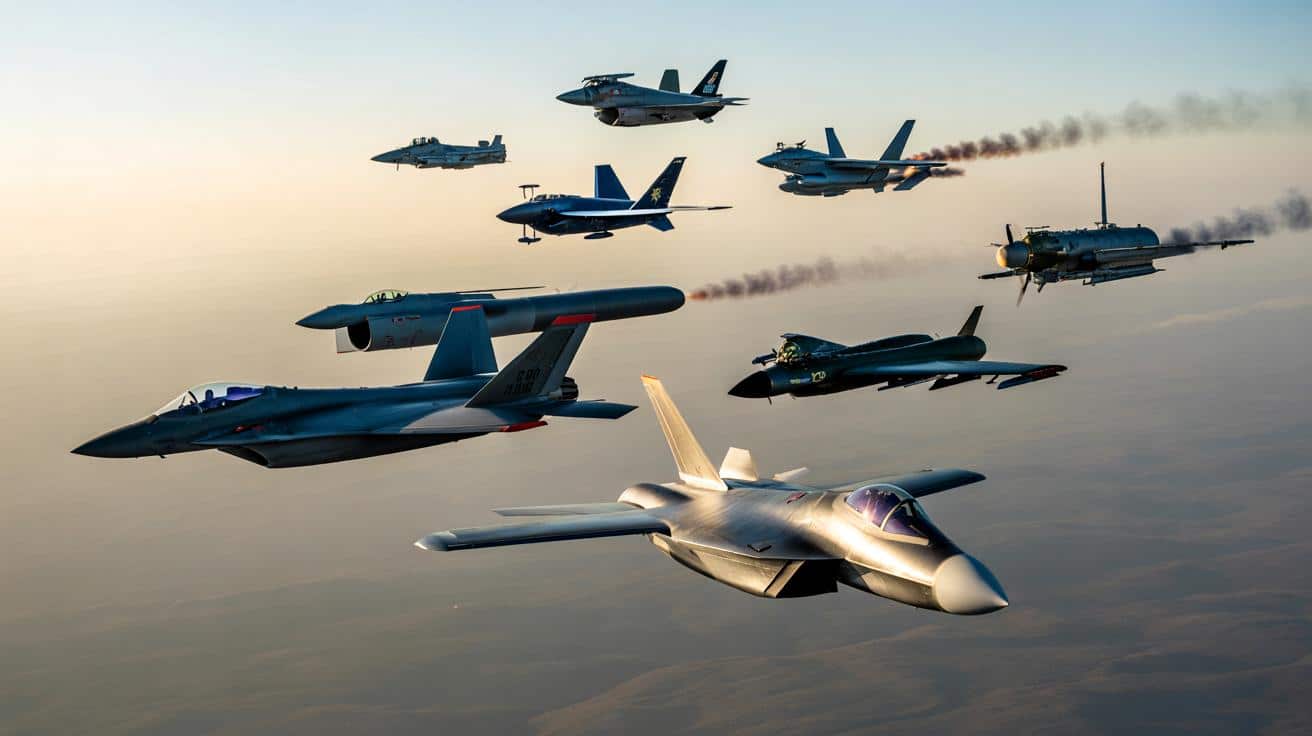
Military planners no longer judge a combat aircraft only by speed or size. What really counts is how far it reaches, how well it hides, and how effortlessly it talks to every asset around it. In that race, eight headline aircraft now stand out as the sharpest tools available to the world’s major air powers.
The new rules of air dominance
Cold War dogfights were once about who could climb faster or pull tighter turns. Today, the equation has shifted. Stealth, networking, long‑range weapons and the ability to switch roles mid‑mission now decide who owns the sky.
Modern “ultimate” jets are less about raw heroics and more about joining sensors, data and weapons into one lethal system.
The eight aircraft below are not just fast or heavily armed. Each brings a specific edge: strategic reach, stealth ambush, brutal payload, or extreme agility. Together, they map how air combat is changing in the 2020s.
B-1B Lancer and F-22 Raptor: hammer and ghost
B-1B Lancer: the long-range sledgehammer
The Boeing B‑1B Lancer still looks like a relic from a different era: huge, swept wings, and four roaring engines. Yet it remains a central part of America’s long‑range strike punch.
- Carries roughly 34 tonnes of weapons, from bombs to cruise missiles
- Powered by four afterburning turbofans pushing over 533 kN of thrust
- Designed for intercontinental missions at high subsonic speeds
Unlike new stealth bombers, the B‑1B is not especially hard to spot on radar. Its value lies in how much firepower it can bring, and how far it can fly without support. In recent conflicts, it has loitered for hours, acting as an airborne magazine of precision weapons for ground commanders.
The B‑1B turns distance into a weapon: it can take off from the US, strike across continents, and land back on home soil.
F-22 Raptor: the air superiority benchmark
The Lockheed Martin F‑22 Raptor, operational since 2005, still sets the standard for stealth air‑to‑air fighters. Designed as a pure air dominance machine, it combines very low radar signature, high altitude performance and a thrust‑to‑weight ratio well above 1.2.
That power lets the F‑22 “supercruise” – fly supersonic without afterburners – and climb away from trouble with ease. It carries air‑to‑air missiles internally to preserve stealth, slipping in, firing first, and leaving before adversaries understand what happened.
➡️ An ‘ingenious’ Ukrainian weapon so disruptive NATO fears it more than Russia does
➡️ Germany contracts Polaris to develop two-stage hypersonic test vehicle
➡️ US reviews plan that could place Greenland defense under total American control
➡️ “I’m a hairdresser and here’s my best advice for 50-year-old women who want short hair”
➡️ Even in winter, you can sprout sweet potatoes for spring
➡️ The Swedish Saab says it is ready to work with Airbus to develop a new fighter jet
The F‑22’s greatest strength is not what you see, but what you never detect until the fight is already over.
F-15EX and Su-57: payload versus agility
F-15EX Eagle II: the heavyweight brawler
The Boeing F‑15EX Eagle II, which entered service in 2021, shows that older designs can be reinvented for digital warfare. Based on the classic F‑15, it adds modern avionics, open‑architecture software and a weapons capacity that borders on excessive.
The aircraft can lug more than 13.6 tonnes of missiles and bombs on up to 23 hardpoints. That lets it act as a “missile truck”, supporting stealth fighters that may carry fewer weapons internally. With a top speed above Mach 2.5, it still moves faster than many newer rivals.
For air forces, the attraction is simple: a proven airframe, room for future upgrades, and enough firepower to saturate enemy defences from stand‑off range.
Sukhoi Su-57: Russia’s bet on manoeuvrability
Operational in Russia since late 2020, the Sukhoi Su‑57 is pitched as a fifth‑generation fighter built around extreme agility. Its three‑dimensional thrust‑vectoring engines let the pilot pull dramatic post‑stall manoeuvres that would defeat many radar‑guided missiles.
The Su‑57 does not match the low observable profile claimed for some US jets, but it favours aerodynamic tricks instead. Its design blends moderate stealth with high energy manoeuvring, aiming to survive both long‑range engagements and close‑in turning fights.
Where US doctrine leans on stealth and first shots, the Su‑57 gambles on outmanoeuvring anything that gets close.
F-35 Lightning II and Eurofighter Typhoon: sensor fusion and flexibility
F-35 Lightning II: the flying data hub
The Lockheed Martin F‑35 Lightning II occupies a different niche. It is not the fastest jet in this list, and its internal weapon load is modest. Its defining feature is information.
The F‑35 fuses inputs from radar, infrared sensors and electronic support measures, then shares that picture instantly with ships, ground units and other aircraft. In many exercises, it has acted as an airborne command node, silently pointing legacy jets towards targets they could not see alone.
The F‑35 turns every mission into a team sport, giving older aircraft a second life through better information.
This networked role has made it popular among NATO members and partners from Europe to the Pacific. Different versions operate from land bases and aircraft carriers, creating a web of connected sensors over wide regions.
Eurofighter Typhoon: the European all‑rounder
In service since 2004, the Eurofighter Typhoon started life as a high‑end air‑to‑air fighter but has grown into a true multirole jet. Twin engines give it strong performance at high altitude, while advanced radars and precision weapons support both air policing and strike missions.
Several European air forces rely on the Typhoon as their front‑line quick reaction aircraft. It can intercept intruding bombers one day and deliver precision weapons against ground targets the next, often within the same deployment.
| Aircraft | Main strength | Primary users |
|---|---|---|
| F‑35 Lightning II | Sensor fusion, networking | US, UK, Italy, Japan and others |
| Eurofighter Typhoon | Agile multirole performance | UK, Germany, Italy, Spain and partners |
MiG-31 Foxhound and Rafale: speed and true multirole
MiG-31 Foxhound: the sprinting interceptor
The Mikoyan MiG‑31 Foxhound remains one of the fastest combat aircraft still in active use, edging close to Mach 3. Built during the late Cold War to cover the Soviet Union’s vast frontiers, it carries a large radar designed to pick up bombers and cruise missiles at long range.
Patrolling at high altitude, the MiG‑31 can rush to distant threats faster than many modern fighters. Russia has kept it relevant by adding updated missiles and sensors, turning it into a platform for long‑range air defence and even anti‑satellite tests.
Where others focus on stealth, the MiG‑31 uses sheer speed and altitude to dominate huge slices of airspace.
Dassault Rafale: one jet, many jobs
The French‑built Dassault Rafale represents a different philosophy: a single type able to handle almost any mission. Rafale squadrons can switch from air defence to deep strike to nuclear deterrence with relatively few changes in configuration.
The jet carries a wide library of weapons, including long‑range cruise missiles and anti‑ship systems. France and several export customers have used it heavily in real combat, from counter‑insurgency to high‑end strike. That combat record has boosted its reputation on the export market.
The next step is tighter integration with unmanned systems. Future Rafale upgrades are planned to command “loyal wingman” drones, sending them forward to scout, jam enemy radars or launch weapons while the crew stays back in relative safety.
What makes these aircraft “ultimate” today
These eight platforms do very different jobs. The B‑1B and MiG‑31 lean on range and speed. The F‑22 and Su‑57 focus on the air‑to‑air fight. The F‑35, Typhoon and Rafale bring flexible strike options and strong networking. The F‑15EX simply hauls more firepower than most rivals.
What connects them is how they fit into wider systems. Each one plugs into satellites, ground radars, tankers and cyber tools. Alone they are formidable; connected, they become force multipliers, shaping land and sea battles far beyond their own cockpits.
The real contest is no longer aircraft against aircraft, but network against network.
Key terms and real-world scenarios
Several concepts often appear in debates about these jets and can sound abstract. Two stand out.
- Stealth: techniques that reduce how easily radars and sensors can detect an aircraft, using special shapes and materials.
- Sensor fusion: software that combines data from many sensors into one clear picture for the pilot and allied forces.
On a tense border patrol, for example, Typhoons or Rafales might fly visibly, signalling presence. At the same time, F‑35s could operate further forward in “silent” mode, mapping enemy radars without being easily tracked. An F‑15EX, loaded with long‑range missiles, might orbit hundreds of kilometres behind as a reserve punch. That mix lets commanders manage escalation while keeping a strong upper hand.
There are risks alongside these advantages. Heavy dependence on secure data links and satellites creates tempting targets for cyber attacks and space weapons. Air forces now train for scenarios where jets like the F‑35 or Su‑57 must fight with degraded data, relying again on pilot skill and onboard sensors rather than constant feeds from elsewhere.
For defence planners and taxpayers, the lesson is blunt: the aircraft themselves matter, but the training, maintenance and digital backbone around them matter just as much. These eight jets highlight where money and attention are going – towards platforms that can adapt, connect and still deliver a decisive strike when politics, and the radar screen, turn suddenly dark.